Showing posts with label Flash. Show all posts

Friday, September 12, 2014

Justice League #37 Variant by Darwyn Cooke

In December, a whole lot o' DC comics will ship with covers illustrated by Darwyn Cooke.  By then, Birds of Prey will be long dead and I have no idea if Black Canary is slated to end up in another book because I haven't paid attention to the solicits since, um, April...?

However, Cooke included Black Canary in the background of his cover for Justice League #37.

That's her way back behind Superman and Batman.
I wondered if there was any reason for this specific assemblage of of heroes.  Cooke expertly depicts a nostalgic sense of whimsy in his covers, so it makes sense that he uses the seven original members of the Justice League of America--Superman, Batman, Wonder Woman, Aquaman, The Flash, Green Lantern, and J'Onn J'Onzz.  But he also includes Cyborg, a founding member of the New 52 Justice League.  But what about Green Arrow and Black Canary?  I can't imagine this is the lineup of the team in issue #37 since J'Onn and Ollie are in Justice League United and for some reason I think Hal Jordan is still off the team playing space cop.

I would be happy if Black Canary joined the main Justice League team.  I think she deserve a shot at it, but it might take a creative team shift to get me interested in reading the comic again.  I like most of what Geoff Johns does, but I don't think he ever had a firm grasp on the League like he did with Green Lantern, the Flash or Justice Society.

Thursday, July 31, 2014

Society Dame: Justice Society of America #8

Previously...


Justice Society of America #8 is written by Len Strazewski with pencils by Grant Miehm, inks by Rich Buckler, and a cover by Tom Lyle featuring Black Canary and Solomon Grundy.  The series is edited by Brian Augustyn along with Mike Gold, who edited Black Canary's miniseries, her ongoing series, and her first arc in Action Comics Weekly.  The issue is cover dated August 1991 and hit the shelves in June.

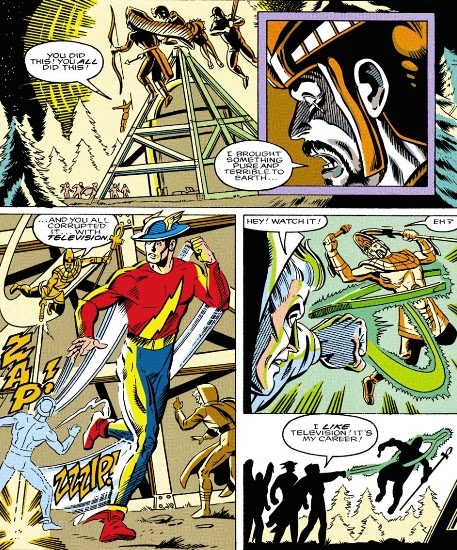
"Vengeance from the Stars Chapter 8: Battle of the Stars" opens with the heroes Green Lantern, The Flash, Hawkman, and Black Canary beset by Vandal Savage dressed as the Egyptian Prince Cheops and a trio of constellation monsters composed of energy.  Except the monsters aren't in their normal mythic form; they look like characters out of television.  And Vandal Savage isn't happy about their new appearance.  Perhaps he doesn't wield as much control over these beings as he made it seem.


Vandal Savage uses the Cosmic Rod he took from Ted Knight to command the energy monster that looks straight out of I Love Lucy to attack Green Lantern.  While Black Canary helps Alan Scott get back to his feet, The Flash speeds around the energy monsters, drawing their attention away from his friends.

The racist caricature of a Native American constellation monster starts a rain dance type of thing before attacking Flash.  Hawkman and his friend, William Wildeagle, scoff at the offensive depiction of one of William's people, and neither of them have the situational awareness to recognize Savage's hired goons creeping up on them with guns.

Eventually, the Joe DiMaggio/Babe Ruth monster nails Green Lantern with his bat, and the "I Love Lucy" monster gets a good shot on The Flash.  It takes the wind and some of his own awareness out of him.


Hawkman barely manages to get an attack on the Indian monster, but it has little effect.  As Savage's goons capture Will Wildeagle, the Justice Society members are surrounded by the constellations which change shape again, this time back to their animal forms.


Before his beasts can finish off the heroes, Savage is confronted by Ted Knight who rises from his wheelchair brandishing a newly created Cosmic Rod of his own.


While Ted fights Savage, Wildeagle disarms his captors and turns the table on the hired goons.


With a lot more practice and expertise with the Cosmic Rod, Starman is able to destroy Vandal Savage's weapon and then the tools he stole from the Gotham Museum, effectively stripping the immortal tyrant from any control over the constellations.

Then Starman turns his attention to the energy beasts and uses the power of his Cosmic Rod to batter at the three otherworldly beasts.


Starman and Green Lantern contain the monsters, the Flash destabilizes the pyramidal structure that Savage erected, and Hawkman flies into the observatory to redirect the telescope.  All of this draws the constellation monsters into the same energy portal that shoots them back up to the stars where they belong.

But what can Black Canary do in this situation?  Defense.


In desperation, Vandal Savage grabs Starman's Cosmic Rod.  Solomon Grundy grabs Vandal Savage. The result is they both end up cast into the heavens with the star monsters, and the heroes rejoice.


Ted Knight confesses that he, too, feared change and ran away from his duty with the Justice Society of America.  He doesn't want to completely forget his normal life at the observatory, but he requests to be reinstated as a member of the JSA if the others consent.  They wholeheartedly do, and the issue ends with them watching television.

That's all for this miniseries, but Len Strazewski and artist Mike Parobeck returned for a second Justice Society series a year later.  Black Canary didn't appear in that series; I think it took place chronologically after she left Earth 2 to join the Justice League of America.

Overall thoughts on this story: It was mostly good.  The different artists were a bit of a hindrance on my enjoyment.  Parobeck was stellar and Miehm was pretty good, so it was fortunate that they drew five of the eight chapters.  More than art inconsistencies, though, I think the big problem with this story is the villains are boring.  I have never cared about Vandal Savage, but this story in particular didn't make him charismatic or even very scary.  And the energy monsters attacking the heroes were both emotionless and flat, as well as repetitive.

What worked was that I like the characters in this book.  Obviously, I love Black Canary, and Hawkman is one of my favorites, although I don't like him in the yellow luchador mask he wears in this series.  I also love Starman and his connection to Dinah, and Green Lantern and Flash both have some nice interactions with her.  This wasn't a great series, but it was fun when the heroes got to play off each other.

The End

Monday, July 28, 2014

Society Dame: Justice Society of America #7

Previously...


Justice Society of America #7 is written by Len Strazewski with pencils by Grant Miehm, inks by Rich Buckler, and a cover by Tom Lyle featuring Black Canary and Solomon Grundy.  The series is edited by Brian Augustyn along with Mike Gold, who edited Black Canary's miniseries, her ongoing series, and her first arc in Action Comics Weekly.  The issue is cover dated August 1991 and hit the shelves in June.

Miehm previously pencilled the Black Canary-focused second issue of the series, which looked pretty great.  That bodes much better for this issue than the last chapter by Tom Artis.

"Vengeance from the Stars Chapter 7: The Return of the Justice Society" opens with Green Lantern Alan Scott and Black Canary happening upon the nefarious Vandal Savage and his undead henchman Solomon Grundy just before they destroy the heroes' compatriots, Hawkman, the Flash, and William Wildeagle.

At the sight of Green Lantern, Solomon Grundy loses what little remains of his mind and rushes to attack.


The Flash uses his super speed to catch Black Canary before she hits the hard ground.  Green Lantern uses his power ring against Grundy, but the magic has little effect, so he calls the Scarlet Speedster back for reinforcements.


Nice of Black Canary to be able to mock the damsel in distress trope as--while she is the least powerful person in the area--she was also the first one to step up and throw down against Grundy.

Meanwhile, inside the Mt. Pride Observatory, a manually and emotionally battered Ted Knight watches his old friends battle valiantly and perhaps futilely against the power of Vandal Savage.  The same power that crushed Ted.  He thinks back to the glory days of the Justice Society of America, before the team broke up and members went their separate ways... before Ted retired his Starman duties to focus on astronomy.

But now, Ted sees that he was wrong to walk away from the responsibility of being a hero.  And for the first time since the first issue, he stands upright in defiance.

Outside the observatory, Vandal Savage is struggling with the damaged Cosmic Rod he stole from Ted while the rest of the heroes try to subdue Grundy.  Hawkman grabs the not-so-gentle giant and lifts him into the air, only to drop him from a great enough height that Grundy leaves a crater in the earth when he lands.  Green Lantern knows, sadly, that's not nearly enough to keep Grundy down.


As the four heroes (and Wildeagle) close in on Vandal Savage, they come under fire from Savage's hired guns, the same hoods who robbed the Gotham Museum and fought with Black Canary back in issue #2.  The boys finally arrive with the stolen loot and Savage dives into their car.  He throws a hook around Grundy and drags the brute back to the observatory where an energy force field goes up, preventing the Justice Society members from following them.

Inside, Ted Knight is frantically working to construct a means of fighting Vandal Savage with spare parts, when the ancient evildoer tosses Ted's own Cosmic Rod at him and demands Ted fix it.  Then Savage takes in the stolen relics from Ancient Egypt: tools, he informs the men, that will grant him total control over the energy monsters he creates and the power to rule the world.

Outside, the four heroes recap the events that brought them to this point.  Realizing they will soon be faced with three different energy monsters when none of them could even defeat just one, they decide to storm Mt. Pride and stop Savage before he can attack.  But they still have the force field to contend with.  William Wildeagle suggests using his ancestor's tomahawk, a wooden weapon that Hawkman used to some success in his battle with the giant woman.

Hawkman throws the tomahawk against the force field, causing a massive energy spike.  Or maybe it has nothing to do with the tomahawk and everything to do with Vandal Savage making a dramatic re-entrance in his best pharaoh fashion.


Savage goes on to monologue about how the monsters went into the modern world to steal "the powers that drive the modern age: electricity, radio and television waves, and atomic power."  He also boasts that he is Cheops, returned to greatness once again.  Hawkman takes issue with that claim because he's a reincarnated Egyptian prince himself and knows who Cheops really was.

Then things take an... interesting turn, when Savage unleashes the three constellation monsters in their true form, which appear to be three television celebrities.


Simply solid issue with some great action beats from Black Canary and The Flash.  It's great to see the heroes working together as a team and interacting rather than fighting electric giants one-on-one.  It's also great to see Ted Knight get his balls back and start to resist the crippling influence of Vandal Savage.

And Miehm's art is without question better than Artis' work on the last issue.  It's not always clean but it is dynamic and energetic.

Come back Thursday for the final chapter of Justice Society of America...

Thursday, July 24, 2014

Society Dame: Justice Society of America #6

Previously...


Justice Society of America #6 is written by Len Strazewski with pencils by Tom Artis, inks by Frank McLaughlin, and a cover by Tom Lyle featuring Black Canary and Solomon Grundy.  The series is edited by Brian Augustyn along with Mike Gold, who edited Black Canary's miniseries, her ongoing series, and her first arc in Action Comics Weekly.  The issue is cover dated August 1991 and hit the shelves in June.

The last issue that Tom Artis drew for this series was the Hawkman-centric issue #4.  That was a shame because I love Hawkman, but Artis' art was pretty lifeless and boring.  This time it's even worse, which sucks because this chapter focuses on Black Canary and Green Lantern fighting in the sky.  But, as we'll see, Artis' art is boring and awful.

"Vengeance from the Stars Chapter 6: Danger Flies the Skies" opens with Black Canary slowly regaining consciousness, pleading with her husband, Larry Lance, to let her sleep ten more minutes.  Then her eyes open fully and she realizes she is dangling high in the sky in the taloned clutches of a giant energy bird, the latest form of the constellation monster Sagittarius.

Green Lantern, caught in the bird's other talon, tells Canary to shut up so he can concentrate.  Real nice, Alan, coming from the crime fighter who can fly if the bird drops you!


Green Lantern struggles and manages to free his left arm from the talon.  He doesn't use his free hand to escape, though, just scratch his nose.  Black Canary tells him that the bird is also carrying a box full of stolen Egyptian relics from the Gotham Museum, and while she's recapping events from issues #2 and #3, a crop-duster soars nearby.

This is no random airplane flying near the bird's path, though, this "borrowed" crop-duster happens to be piloted by Doiby Dickles, the buffoonish cab driver that took palled around with Green Lantern before usurping his feature in All-American Comics.  Dickles flies close enough to tell Green Lantern he brought the special item, but the bird takes notice.  Sagittarius swoops down to attack the crop-duster and Doiby leads it on some fun little aerial acrobatics that make Black Canary nauseous.

Well, they should have been fun aerial acrobatics, but Tom Artis' layouts and panel construction are so flat that the motion and energy of the stunts is lost.  Anyway, Doiby gets out of the pilot's seat and hands Alan Scott the green power lantern.


Sagittarius doesn't like this at all and dives down toward Doiby who is trying to regain control of the plane.  Green Lantern uses this time to speak the oath that powers his magic ring.


Alan creates an energy projection to pluck the bird's hind feathers, causing Sagittarius to drop Green Lantern and Black Canary.  Green Lantern creates a green parachute for Dinah, allowing her to settle gently on Doiby's plane while Alan turns around to combat the bird monster.


Meanwhile, on the ground below, Vandal Savage's henchmen watch the fight in the sky while Solomon Grundy rages about wanting to kill Green Lantern.  The henchmen use reverse psychology on Grundy to get him to pick up the fallen box of Egyptian loot and put it in another plane.  Then they take off for New Mexico and the Mt. Pride Observatory where their evil master awaits.

Back in the sky, Green Lantern tries to cage the bird with his power ring but it doesn't work.  The bird is too powerful and it shoots energy beams out of its eyes that knock Alan unconscious.  He begins to fall, but the ring keeps his descent slow and steady.  But that puts him in danger of Sagittarius' beak and claws.

Doiby flies the plane near the bird and releases its tanks of insecticide smoke in Sagittarius' face.  The monster is distracted enough fro Black Canary to climb out onto the plane's wing and catch Green Lantern.


Black Canary brings Alan around and asks if he can absorb the monster's energy using his lantern and he thinks it's a great idea.


Green Lantern flies out again, but this time when Sagittarius fires its deadly eye-beams, Alan catches them with his green power lantern and siphons the monster's stolen energy.  Weakened, the bird flies off.  Green Lantern and Black Canary are able to follow the bird, sending Doiby off on his own to hopefully die a horrible death.

The heroes follow Sagittarius to the Mt. Pride Observatory where their friend, Ted Knight, works.  Sagittarius disappears into the massive antenna relay that has been constructed around the observatory.  As the heroes get closer, they find Vandal Savage gloating over the half-conscious forms of Hawkman and The Flash.  They witness William Wildeagle shoot Ted Knight's Cosmic Rod out of Savage's hand, but then Solomon Grundy sneaks up on Wildeagle.


After the awesomeness of Mike Parobeck last issue, it really sucked to endure Tom Artis' pencils in this issue.  They're not terrible on their own, but they don't compare to Parobeck or Rick Burchett or Grant Miehm.  And the greatest problem is the uninspired panel construction and layout.  Every page is based on a six panel grid.  Occasionally, two panels will merge into one or he'll give us a splash, but they're never anything impressive.  I don't know if he was trying to emulate the simplistic style of Golden Age comics.  I also don't know why this eight issue series needed four different artists.  Either way, this issue suffered.

It's also not the best story.  It's just as formulaic as the rest; the aerial combat with the energy monster really isn't powerful enough to take up two thirds of the book, and the last two pages cover stuff we already know.  Plus, Doiby Dickles is lame.  All in all, this isn't a great way to lead into the final two issues of the series, but they should pick up.

Come back Monday for the next chapter of Justice Society of America...

Monday, July 21, 2014

Society Dame: Justice Society of America #5

Previously...


Justice Society of America #5 is written by Len Strazewski with pencils by Mike Parobeck, inks by Rick Burchett, and a cover by Tom Lyle featuring Black Canary and Solomon Grundy.  The series is edited by Brian Augustyn along with Mike Gold, who edited Black Canary's miniseries, her ongoing series, and her first arc in Action Comics Weekly.  The issue is cover dated August 1991 and hit the shelves in June.

"Vengeance from the Stars Chapter 5: Double Star Rising" begins with the fastest man alive, Jay Garrick, alias The Flash, rapidly assembling an energy detecting geiger counter out of spare parts.  He grabs the device and rushes across the American military base to where Hawkman is being treated for injuries sustained last issue.  The base doctor suspects Hawkman has a concussion, but Hawkman refuses any further treatment now that Flash is there and ready to roll.

A boyish-looking enlisted soldier tells Hawkman that a Native American named William Wildeagle is outside waiting for him.  Wildeagle is the friend of Hawkman's archaeologist alter-ego, Carter Hall.  When Hawkman and Flash greet him outside the base hospital, Wildeagle makes it clear that he knows who his friend is, mask or not.


The three of them head off running and flying to New Mexico, which happens to be home to the Mt. Pride Observatory, where Ted Knight works.

Knight isn't in very good shape right now, though, as he's been tortured and enslaved by Vandal Savage.  The immortal evil-doer has taken over the Observatory and reconstructed the outer facade to look more like a pyramid; the observatory now siphons every type of energy to fuel the Cosmic Rod he stole from the former Starman, Ted Knight.

Savage reminds his hostage, Ted, that soon he will be joined by his old Justice Society colleagues, Green Lantern and Black Canary.  But when the phone rings, Savage learns that The Flash and Hawkman are still alive and coming for him.


Meanwhile, somewhere between here and there, Hawkman realizes maybe he should have let the doctor do a more thorough examination.


Flash tells the others they're close to Mt. Pride and Hawkman wonders if the crazy star monsters are connected to Ted Knight's work.  With some amount of dread, Flash suspects there is, indeed, a connection.  He gives the geiger counter to William Wildeagle and asks the man to catch up on foot while he and Hawkman approach the observatory, which now seems to be glowing.

When they approach, the sky is lit up by the female energy monster that Hawkman squared off against last issue.  The giant is standing around the scaffold of the pyramidal observatory, feeding energy into or from the structure.  Flash and Hawkman concoct a plan to trip the monster into the scaffolding, hoping it will ground her and shut off the power.

They run and fly around her until she contacts the scaffold, but it doesn't draw energy from her.  It juices her up.  Also, the dog monster that Flash fought in the first issue returns, and then changes back into the giant humanoid with a club, so now each of the Justice Society members has an energy giant with which to contend.

Hawkman is nearly battered by one of the giants; his reflexes and fighting ability are still a bit shaky from the concussion.  Flash manages to trip one monster into the other in an attempt to get his friend to safety, but when he tells Hawkman to leave, they notice that physical contact between the giants caused a power disruption.


Hawkman reasons that the monsters' weakness is each other and the heroes spring back into action to stop the beasts.  This time, with a plan.


The energy giants collapse into each other and dissipate.  Inside the observatory, Vandal Savage snarls a curse at this setback.  He grabs Ted Knight's Cosmic Rod and propels himself through the skylight.  Ted is only too glad to be rid of Savage, and begins working on something as soon as his captor is out of sight.

Outside, Vandal Savage makes his presence known to Hawkman and The Flash and takes them out of the fight just as quickly with the energy of the Cosmic Rod.  As he gloats over the stunned heroes, however, a gunshot rings out over the desert and a rifle slug knocks the rod out of Savage's hand.  William Wildeagle comes down the path holding a rifle trained on Vandal Savage, telling the villain to surrender.

Wildeagle doesn't realize, though, that Vandal Savage's monstrous servant has returned.


The first four issues of this series were pretty good, but man this one was so much better.  A lot of that credit can be attributed to Mike Parobeck, whose art was so classy and distinguished that it still saddens me that the man died so early in his comics career.  He made solid gold of books like Elongated Man and Batman Adventures, and I know he would have been very successful today if he'd survived.

Staying on the art for a minute: Hawkman is one of my all-time favorite heroes, but I have never, ever liked this version with the Mexican wrestler-looking luchador mask.  Hawkman's helmet is one of my favorite pieces of art design, so it sucks to see him reduced to such a commonplace cowl.  That said, this is probably the best it has ever been rendered because Mike Parobeck just rocks the design in every way.

What else makes this issue stand out is that finally, finally our heroes have someone to talk to besides themselves and endangered bystanders.  Sure, Hawkman and Flash can be solo acts, but this series is called Justice Society of America; let's see the team work together already!  And they do--really, really well!  I also think it's fun that Strazewski put these two heroes together for the first team-up given that they co-headlined Flash Comics in the 1940s.

Come back Thursday for the next chapter of Justice Society of America...

Thursday, July 17, 2014

Society Dame: Justice Society of America #4

Justice Society of America #3 is written by Len Strazewski with pencils by Tom Artis, inks by Frank McLaughlin  Burchett, and a cover, once again, by Tom Lyle.  The series is edited by Brian Augustyn along with Mike Gold, who edited Black Canary's miniseries, her ongoing series, and her first arc in Action Comics Weekly.  The issue is cover dated June 1991 and hit the shelves in April.

"Vengeance from the Stars Chapter 4: Evil of the Ancients" begins with archaeologist Carter Hall being led into a cave by William Wildeagle, a Native American expert in ancient tribal art found in the southwestern United States.  The power generating the lights in the cave flickers on and off as this part of the story takes place at roughly the same time as the previous two issues.

In the cave, William shows Carter some tribal wall art that dates back thousands of years and depicts animals and images created in the same style as cave paintings found throughout the world.  The two scientists speculate on what could have caused different races and cultures separated by oceans and eras to focus on the same types of mythological concepts.  Carter suggests the possibility of shared "racial memory"...


So Carter's theory suggests that giant monsters from the heavens may have terrorized prehistoric man to the point of inherited fears and superstitions being passed on throughout the ages.  He recognizes it's a crazy, not scientific idea, but William doesn't dismiss it at all.

Then the earth shakes and Carter thinks an earthquake has rocked the area but William knows that an atomic bomb has been set off nearby.  The two archaeologists don't have time to escape the blast, but thankfully, an enormous and slightly familiar figure sucks up the energy from the atomic explosion, saving their lives.


Carter realizes that the being looks like the constellation Andromeda and that its presence on earth seems to confirm his theory about the ancients.  William is less concerned with the theories than with survival.  Andromeda is heading toward a nuclear warhead depot and they need to get out of their immediately.  They drive away in William's jeep; Carter gets out at the museum while William goes to get the army for help.

In the museum, Carter puts on the Nth metal wings and mask of his heroic alter ego, Hawkman.  He also grabs an ancient spear and shield.


By the time Hawkman catches up to Andromeda, she is at the warhead depot and beating the crap out of the army and their tanks.  He tries to distract the monster, and she shoots him with lasers from her eyes.  The lasers are rebuffed by the wooden shield and he figures that while the constellation seems to absorb energy, it has a weakness to wood, just like Green Lantern.


Hawkman advises the army to build wooden battering rams to fight it while he spears Andromeda in the hand.  She lashes out savagely and knocks him around, but he regroups and grabs the chain that is linked to her arm.  He wraps her up and binds her, but Andromeda changes shape into a pegasus and bats him into the cliff face.


Andromeda/Pegasus reaches into the depot and pulls out three nuclear warheads.  The winged horse takes off into the sky with Hawkman in pursuit, but before he can get close enough to retrieve or disarm the warheads, she blasts him with her powerful beams.  The energy destabilizes his Nth metal and Hawkman begins to plummet to his death.


Thinking he's about to die, Hawkman sends out a silent declaration of love to his wife, but The Flash catches him in the nick of time.  They stumble relatively unharmed and then get up to watch the constellation monster fly away.  Now able to compare notes on their individual bouts with these monsters, Hawkman and The Flash team up.  Now we see how four solo heroes are starting to come together as one unit.

Even though I like Hawkman better than The Flash, Green Lantern, and yes, even Black Canary, this was easily the weakest of the four issues so far.  For one thing, we have seen and heard this same story four times in a row.  Carter Hall doesn't add much beyond speculation that these monsters may have visited Earth before in the ancient past, but I'm not sure how that's relevant.  Even with the immortal Vandal Savage as our primary antagonist, it sounds like he wasn't the one responsible for unleashing these monsters back in the day so I don't need that kind of backstory.

Also, the action sequences in this story aren't that spectacular and I blame a lot of that on the artist.  I don't know Tom Artis from any other book, but it looks like he recycles a lot of the same poses and shots for Hawkman within this book from page to page.  He never lets the character spread his wings; the panels are always too small and confined for Hawkman.

Anyway, this may be the low point, but now the characters are coming together so next issue ought to turn things around.

Come back Monday for the next chapter of Justice Society of America...

Wednesday, July 9, 2014

Team-Up: SECRET ORIGINS #32 (Nov 1988)

I wrote up a nice little introduction for this review explaining how Black Canary replaced Wonder Woman in the Justice League's original lineup after the universe-altering events of Crisis on Infinite Earths.  Then I read Mark Waid's "Secrets Behind the Origins" segment in the letters' column of Secret Origins #32 and realized--to absolutely no one's surprise--that he put it a hundred times more clearly and concisely than I could:

"When the decision was made to retell the origin of the original Justice League of America (first shown in JLA #9, 1962), certain publishing realities affected the story; most important, in DC's post-Crisis universe, Wonder Woman didn't make her heroic debut until long after her former comrades Aquaman, Martian Manhunter, Flash and Green Lantern.  Plotter Keith Giffen and editor Mark Waid briefly discussed the idea of simply leaving a female member out of the original JLA but eventually dismissed the idea.  Not only was the League never really a "boys club," but there was something more substantive and--oh, gosh, just more "leaguish"-- about a five-member team... which is how Black Canary ended up being the fifth "mystery" member of the Justice League of America."

Yeah, that's better that mine.


Secret Origins #32: "All Together Now" is scripted by Peter David from a Keith Giffen plot based on the original story from Justice League of America #9 by written by Gardner Fox; Eric Shanower drew the heck out of the issue, with Gaspar providing lettering, Gene D'Angelo the coloring, and Mark Waid editing.  Shanower's cover shows the new old League monitored on screen by current members of Justice League International.

On the distant alien world of Appellax, the ruling Kalar has died.  According to Appellaxian custom, whoever assassinated the former Kalar gets to be the new one, but seven different Appellaxians are all claiming credit for the murder.  An Appellaxian official, like a grand vizier or something, explains the other Appellaxian custom that the seven candidates must battle to the death for the right to be crowned Kalar.

The problem is these types of civil disputes have historically decimated Appellaxian populations, so the vizier tells them they will have to fight on planet Earth.  The seven contenders' minds are transferred into host bodies of different forms and rocketed to Earth in seven meteors.

The first of the meteors lands near Middleton, Colorado, where the Martian Manhunter soars high enough over his city that no would can recognize his alien form.  As he wonders doubtfully whether people of Earth would accept him if they knew the truth, he views a bizarre happening down below.


The statues, J'Onn realizes to his horror, are the people of Middleton.  What could have caused this horrific transformation, he doesn't know, but from roughly a mile away J'Onn hears the thudding steps of a giant creature.  Turning invisible, J'Onn follows the sounds until he finds the first contender in the shape of the giant Stone God.

The Stone God shoots eye-beams that change people into stone statues.  The Martian Manhunter flies around using his super-Martian-strength to punch the stone monster.  It has no effect, so he switches tactics and tries probing the Stone God with telepathy.  That, too, fails, and even worse, the psychic backfire hurts J'Onn and gives the Appellaxian the knowledge of his Martian enemy, particularly his weakness to fire.

The Stone God wrecks a gas station and then ignites the gasoline, creating an inferno that threatens to engulf the Alien Atlas (that's for you, Frank).  Still invisible, J'Onn crashes into a fire hydrant, using the water to fend off the blaze and rejuvenate his powers.  The giant walks off, and for a moment J'Onn considers waiting long enough for the fire to burn itself out... But that would put more people in danger.  The Martian Manhunter will not be paralyzed by fear.


With all his Martian might and resolve, J'Onn flies through the inferno and smashes into the Stone God, shattering the Appellaxian's battle form.  The effort, while successful, is enough to knock J'Onn unconscious.  This is a really strong moment for Martian Manhunter and it would be a great, iconic page except that J'Onn is invisible for almost the entire scene.  The drama of the moment is a little undercut when the hero appears as barely any more than thought bubbles.

When he awakens, the people of Middleton have reverted back to normal.  And they're quite intrigued by the green-skinned humanoid among them, meeting the honesty of his Martian origin with incredulity and speculation.  J'Onn doesn't stick around long.  During his brief telepathic connection to the Appellaxian, he learned that six more were bound for Earth.  He takes off looking for the next would-be alien conqueror.

And one of those aliens has landed in the middle of the sea where we find Aquaman who only just found Atlantis earlier that day, putting this story canonically right after Aquaman's flashback tale in Adventure Comics #260.


After the second Appellaxian, the Mercury Monster, transforms Aquaman into a floating blob of mercury, he needs to resist panic and his own insecurities and figure out what to do.  Unable to do anything but ride the currents, Aquaman tries to attack the Mercury Monster, but that proves futile.  His movement is limited and haphazard and the Appellaxian has control over Aquaman and the other fish and sea life it has transformed to liquid metal.  At one point, Aquaman freaks out because one of his arms is almost separated.  This seems particularly noteworthy in hindsight, because writer Peter David would take Aquaman's hand off in a story five years after this.

Aquaman is near despair.  He doubts the formidability of his powers and his status as a hero.  But when the Mercury Monster heads toward Atlantis, Aquaman realizes he must act and defend his newfound home and people.  He spies a nearby whirlpool and suspects that the mercury blob would have no conception of what the whirlpool can do; all it wants is to convert more fish to mercury and bolster its forces.

Aquaman uses his telepathic powers to send the fish toward the whirlpool.  The Mercury Monster follows the fish until it is caught by the whirlpool's force and ripped apart.  The effect of the alien's death transforms Aquaman back to normal.


Damn, Aquaman!  You think your powers are useless and Superman wouldn't have anything to do with you?  Get some confidence already.

Elsewhere, a fledgling hero steps out one one of her first adventures.


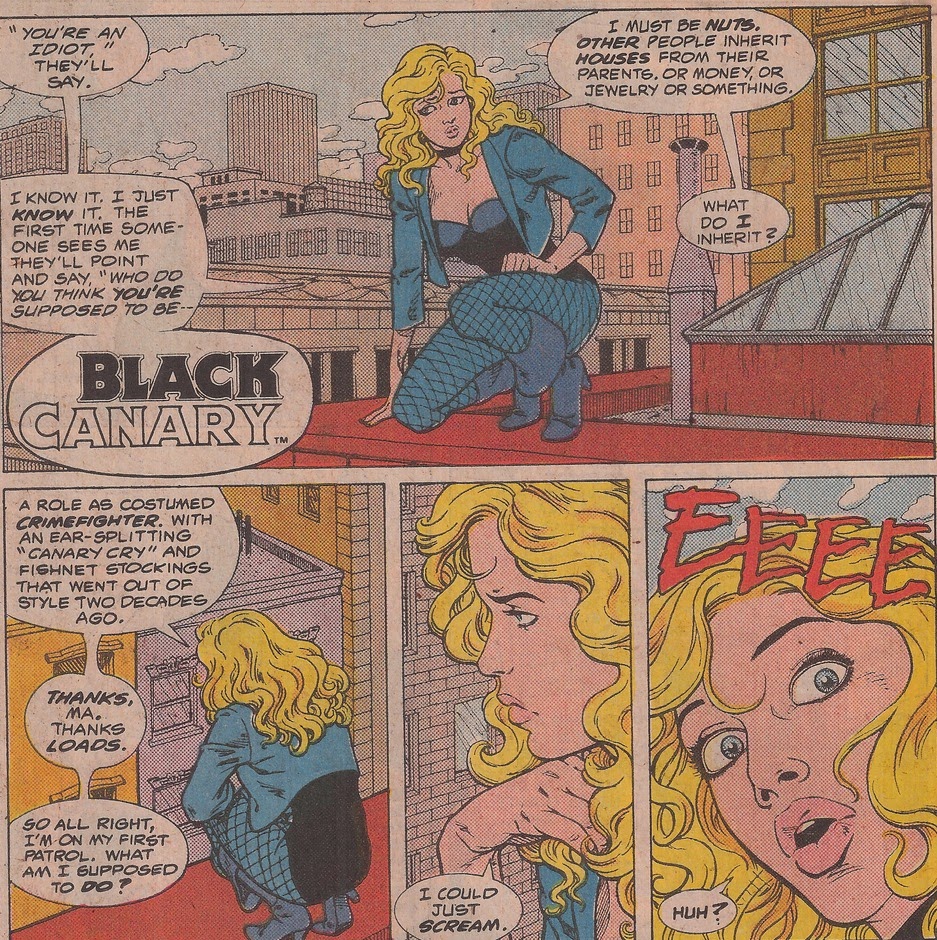
Hearing the sound of a scream, Black Canary leaps into action, jumping from a fire escape to the alley before.  She sees someone harassing a woman and--taking a moment to deepen her voice so the perpetrator will take her seriously--demands the mugger surrender.

Except it's not a mugger; it's Glass Man, the third Appellaxian, who uses eye beams to turn people into glass.  The Glass Man tries to shoot Black Canary, but she dives out of the way.  Retreating to the street, she realizes that the monster has transformed even more people into glass.  Also, he's still coming for her.  She leaps away, but the Glass Man's gaze manages to turn one of her legs to glass.

The Appellaxian laughs at his prey, and that's enough to really piss her off.


Black Canary manages to get information about the meteor landing in the Everglades.  Black Canary speeds down to Florida in her car and sneaks past the police barricade.  She makes her way through the dense foliage, crossing her fingers that she doesn't ruin her fishnet stockings.  She spots the meteor... and something more.  A tree in humanoid shape speaking in an alien tongue.  When Black Canary approaches, she becomes frozen and demands the tree-person free her.  Now speaking in English, the tree-person says he is not responsible, that he is as much a prisoner as she.

Meanwhile, Hal Jordan, the Green Lantern of Space Sector 2814, returns to Earth after meeting the Guardians of the Universe and other members of the Green Lantern Corps for the first time.  This would put this story right after the events of Green Lantern #1 from 1960.


Hal's interest in the meteor picks up when he sees it suddenly change speed and direction.  Instead of burning up in Earth's atmosphere like a good meteor, this one crashes relatively safely in Africa.  Hal pursues the object in curiosity, while mulling over a few heroic catchphrases in his head.

From out of the meteorite comes the fourth Appellaxian contender in the shape of a giant yellow bird.  This Golden Roc fires eye beams that, just like the others, transform other people and creatures into beings not unlike itself.  Green Lantern's ring, of course, is useless against the color yellow but he dries some indirect attacks against the Golden Roc.  Faster than he expects the bird to move, it grabs Hal in its golden talons, and its touch begins changing Hal into a gold feathered creature.

Hal fires his ring into a cloud setting off a hail storm that distracts the Golden Roc enough that it lets Hal go.  Still in danger of changing, Green Lantern leads the big yellow bird on a chase into a waterfall.  When the Roc flies into the waterfall, Green Lantern freezes the water.  This destabilizes the Appellaxian's battle form enough that Hal and the other animals changed by the Roc revert back to their normal form.

After taking the animals to a zoo, Green Lantern realizes that more meteors have crash-landed on Earth.  He heads off toward the one meteorite believed to be unopened in the Florida Everglades.  When Hal arrives, voices from the woods try to warn him.

In England, the Flash had been meeting the Queen when he was asked to help put out some fires in the South London down of Croydon.  When the Flash arrives, he is shocked to see a Fire Giant, the fifth Appellaxian in a form that looks like, well, like a fire giant.  Barry Allen tries to blow out the Fire Giant by waving his arms at super-speed, but it only seems to embolden the Fire Giant.

The monster glares at Flash, which causes Flash to begin to transform into flame.  He immediately vibrates his molecular structure at the speed necessary to break the Fire Giant's connection.  Then Flash runs over to a standing body of water and circles it fast enough to suck up the water in a vortex and dump it on the Fire Giant.


When wind, water, and sand fail to extinguish the Fire Giant, Barry remembers the basic Flash Fact that fire requires oxygen to burn.  So he runs around the Fire Giant at such super-speed that he removes the oxygen from the surrounding air.  At last, the Appellaxian collapses, its battle form ruined.  The alien screams to unseen forces that he doesn't want his mind ripped from him, that he wants another chance.  Then he slumps over dead.

The Flash speaks to some of the Croydon citizens and one of them tells Flash about the other alien meteors arriving on Earth.  Flash runs across the Atlantic Ocean to arrive in the Everglades after the other heroes.  But when he arrives, he, like them, is transformed into a living tree.


The heroes banter for a short time and J'Onn tries to understand how they use humor to fend off terror.  Then the meteorite cracks open and the sixth Appellaxian steps out in the form of the Wood King.  This alien reveals to the heroes that he intentionally delayed his arrival, and now, thanks to Aquaman and the others (not that Aquaman and the Others), the alien only has one more contender to destroy before he can become Kalar of his home world.

The Wood King psychically commands the five heroes to follow him to Antarctica to battle the last Appellaxian.  Aquaman has no desire to walk from Florida to Antarctica, and little desire to serve as a tree soldier for the Wood King.  Using his own telepathic abilities, he is barely able to control his own physical body; it's not much, but it's enough to knock into Martian Manhunter who knocks into Green Lantern.  Using his own mental abilities, J'Onn is able to resist the Wood King's influence enough that he scrapes off the wood around Hal Jordan's ring.  Green Lantern only has enough will and aim to shine his ring's light on Black Canary's head, freeing her from the Wood King's power just temporarily.


Black Canary uses her Canary Cry on the Flash, pitching it at just the right frequency that it shatters the wood around his body, freeing the Fastest Man Alive.  The Flash launches himself at the Wood King with a volley of "a million high-speed punches".  He basically beats the Wood King to splinters, destroying the penultimate Appellaxian's battle form.


The five heroes agree to work together in bringing down the final Appellaxian.  Green Lantern and J'Onn J'Onzz fly, with Hal carrying Black Canary, Aquaman and the Flash in a bubble created by his ring.  During the journey south, Martian Manhunter notes that Green Lantern seems to be the only one completely at ease with an alien in their ranks.  Green Lantern, who just hours ago discovered he was part of an intergalactic peacekeeping force full of aliens, shares his first name, "Hal" to which the Manhunter from Mars says, "J'Onn."

When the group finds the meteorite in Antarctica, the Crystal Creature has already freed itself.  But it also ran afoul of Superman who has just destroyed the last Appellaxian.  The Man of Steel dusts off his hands and takes off, seemingly not noticing the heroes behind him (although with his super-senses, that seems nearly impossible).  The group is bummed out by their non-brush with celebrity and Black Canary mentions she was looking forward to working all together to fight the Crystal Creature.  "Safety in numbers," she says.  That lights up a bulb over Flash's head and he gets an idea.

Flash pitches the idea of working together as a team.  J'Onn is reluctant because it would require him to publicly out himself, but Barry counters that revealing himself in the context of joining other heroes would be good publicity for the Martian Manhunter--and for all of them.  Black Canary, as the youngest and least experienced of the group, says she loves the idea, that it would feel like a return of the old Justice Society of America.  Hal Jordan floats the team name Justice Society II, which gets shot down, and Barry floats the idea of The Avengers, but Dinah tells him they'll be confused by the TV show about British spies.

Finally they come to the name...


Within the clouds of future members of the Justice League of America are The Atom, Batman, Elongated Man, Firestorm, Green Arrow, Gypsy, Hawkgirl, Hawkman, Phantom Stranger, Red Tornado, Snapper Car, Steel, Vibe, Vixen, and Zatanna.  The notable absences are, of course, Superman who we saw earlier this issue and Wonder Woman, who we established was no longer part of the Justice League and wouldn't encounter the other heroes until the Legends miniseries event.

Peter David is one of the best writers in comics of the last twenty-five years so he's not going to script a crappy Justice League comic.  Keith Giffen and Mark Waid took Gardner Fox's decades-old story and fluffed it up a bit, and David added the right voices and little details that made the characters resonate so well.  With the exception of Aquaman being so down on himself, every character feels pretty right for the time.  J'Onn is a little paranoid of himself and stays hidden until he's encouraged by Green Lantern and the Flash.  Hal Jordan feels appropriately cocky given the weight of their situation, and Black Canary has the spitfire of a young woman looking to prove herself to her mother.

Eric Shanower's art is fan-freaking-tastic in this comic.  I've never really noticed his work before this issue, but it blew me away, particularly his rendering of human faces and expressions.  There's something similar to Mike Allred in how Shanower draws Aquaman and Hal Jordan, and most of his depictions of Black Canary are lovely and luscious.

So did I have any problems with this?  Well, not the issue so much as the effect Crisis on Infinite Earths had on the issue.  This may sound absurd coming from a guy who runs a Black Canary blog, but I don't think she should be a founding member of the Justice League of America.  I love Dinah, but she's not a heavyweight of that caliber.  Wonder Woman should always be one of the original members of the Justice League, as should Superman and Batman.  And their absence is noticeable in both this story and in JLA: Year One, the maxi series that serves as a sequel to this book.  In both of the stories, the League members seem a little rudderless; they lack leadership.  If Wonder Woman was part of this issue or Year One, the League would never feel leaderless.

Speaking of JLA: Year One, I suppose I should review that series sometime soon but there's a lot of other stuff I'm more excited about first.  Hopefully, before the year is over.