Showing posts with label Origin. Show all posts

Friday, April 10, 2015

Episode 7: Happy Birthday, Black Canary--Now DIE!!!

The first Flowers & Fishnets team-up: Ryan Daly welcomes Chris Franklin from the SUPER MATES PODCAST to talk about Justice League of America issues #219-220. These issues change everything readers thought they knew about Dinah Lance!

You can follow along with these issues by reading my original review of Justice League of America #219 right here, and issue #220 right here.

Find Chris and his wife, Cindy, at the Super Mates Podcast!

Sample pages from Justice League of America #219-220.


Music this episode:
"Farewell Daddy Blues"
Margot Bingham
ABKCO, 2014.


CLICK HERE TO PLAY EPISODE IN ANOTHER WINDOW.

Saturday, February 28, 2015

Episode 1: The Origin of Black Canary

Spinning off from Flowers & Fishnets: A Black Canary Blog comes the podcast that celebrates DC Comics' blonde bombshell, Black Canary. This episode, host Ryan Daly recalls how he came to appreciate the popular character. Also, a review of "The Canary is a Bird of Prey", the first printed origin of Black Canary from 1978.

I have already covered this story for the blog. Click here to read my review and follow along with the story!

Flowers & Fishnets is available for download on iTunes by clicking here, or you can check out the show's RSS feed by clicking here.

Sample pages from DC Special Series #10:


Music this episode:
"It's a Man's Man's Man's World (Glee Cast Version)"
Dianna Agron/The Cast of Glee
Columbia Records, 2010.

CLICK HERE TO PLAY EPISODE IN ANOTHER WINDOW.

Wednesday, July 9, 2014

Team-Up: SECRET ORIGINS #32 (Nov 1988)

I wrote up a nice little introduction for this review explaining how Black Canary replaced Wonder Woman in the Justice League's original lineup after the universe-altering events of Crisis on Infinite Earths.  Then I read Mark Waid's "Secrets Behind the Origins" segment in the letters' column of Secret Origins #32 and realized--to absolutely no one's surprise--that he put it a hundred times more clearly and concisely than I could:

"When the decision was made to retell the origin of the original Justice League of America (first shown in JLA #9, 1962), certain publishing realities affected the story; most important, in DC's post-Crisis universe, Wonder Woman didn't make her heroic debut until long after her former comrades Aquaman, Martian Manhunter, Flash and Green Lantern.  Plotter Keith Giffen and editor Mark Waid briefly discussed the idea of simply leaving a female member out of the original JLA but eventually dismissed the idea.  Not only was the League never really a "boys club," but there was something more substantive and--oh, gosh, just more "leaguish"-- about a five-member team... which is how Black Canary ended up being the fifth "mystery" member of the Justice League of America."

Yeah, that's better that mine.


Secret Origins #32: "All Together Now" is scripted by Peter David from a Keith Giffen plot based on the original story from Justice League of America #9 by written by Gardner Fox; Eric Shanower drew the heck out of the issue, with Gaspar providing lettering, Gene D'Angelo the coloring, and Mark Waid editing.  Shanower's cover shows the new old League monitored on screen by current members of Justice League International.

On the distant alien world of Appellax, the ruling Kalar has died.  According to Appellaxian custom, whoever assassinated the former Kalar gets to be the new one, but seven different Appellaxians are all claiming credit for the murder.  An Appellaxian official, like a grand vizier or something, explains the other Appellaxian custom that the seven candidates must battle to the death for the right to be crowned Kalar.

The problem is these types of civil disputes have historically decimated Appellaxian populations, so the vizier tells them they will have to fight on planet Earth.  The seven contenders' minds are transferred into host bodies of different forms and rocketed to Earth in seven meteors.

The first of the meteors lands near Middleton, Colorado, where the Martian Manhunter soars high enough over his city that no would can recognize his alien form.  As he wonders doubtfully whether people of Earth would accept him if they knew the truth, he views a bizarre happening down below.


The statues, J'Onn realizes to his horror, are the people of Middleton.  What could have caused this horrific transformation, he doesn't know, but from roughly a mile away J'Onn hears the thudding steps of a giant creature.  Turning invisible, J'Onn follows the sounds until he finds the first contender in the shape of the giant Stone God.

The Stone God shoots eye-beams that change people into stone statues.  The Martian Manhunter flies around using his super-Martian-strength to punch the stone monster.  It has no effect, so he switches tactics and tries probing the Stone God with telepathy.  That, too, fails, and even worse, the psychic backfire hurts J'Onn and gives the Appellaxian the knowledge of his Martian enemy, particularly his weakness to fire.

The Stone God wrecks a gas station and then ignites the gasoline, creating an inferno that threatens to engulf the Alien Atlas (that's for you, Frank).  Still invisible, J'Onn crashes into a fire hydrant, using the water to fend off the blaze and rejuvenate his powers.  The giant walks off, and for a moment J'Onn considers waiting long enough for the fire to burn itself out... But that would put more people in danger.  The Martian Manhunter will not be paralyzed by fear.


With all his Martian might and resolve, J'Onn flies through the inferno and smashes into the Stone God, shattering the Appellaxian's battle form.  The effort, while successful, is enough to knock J'Onn unconscious.  This is a really strong moment for Martian Manhunter and it would be a great, iconic page except that J'Onn is invisible for almost the entire scene.  The drama of the moment is a little undercut when the hero appears as barely any more than thought bubbles.

When he awakens, the people of Middleton have reverted back to normal.  And they're quite intrigued by the green-skinned humanoid among them, meeting the honesty of his Martian origin with incredulity and speculation.  J'Onn doesn't stick around long.  During his brief telepathic connection to the Appellaxian, he learned that six more were bound for Earth.  He takes off looking for the next would-be alien conqueror.

And one of those aliens has landed in the middle of the sea where we find Aquaman who only just found Atlantis earlier that day, putting this story canonically right after Aquaman's flashback tale in Adventure Comics #260.


After the second Appellaxian, the Mercury Monster, transforms Aquaman into a floating blob of mercury, he needs to resist panic and his own insecurities and figure out what to do.  Unable to do anything but ride the currents, Aquaman tries to attack the Mercury Monster, but that proves futile.  His movement is limited and haphazard and the Appellaxian has control over Aquaman and the other fish and sea life it has transformed to liquid metal.  At one point, Aquaman freaks out because one of his arms is almost separated.  This seems particularly noteworthy in hindsight, because writer Peter David would take Aquaman's hand off in a story five years after this.

Aquaman is near despair.  He doubts the formidability of his powers and his status as a hero.  But when the Mercury Monster heads toward Atlantis, Aquaman realizes he must act and defend his newfound home and people.  He spies a nearby whirlpool and suspects that the mercury blob would have no conception of what the whirlpool can do; all it wants is to convert more fish to mercury and bolster its forces.

Aquaman uses his telepathic powers to send the fish toward the whirlpool.  The Mercury Monster follows the fish until it is caught by the whirlpool's force and ripped apart.  The effect of the alien's death transforms Aquaman back to normal.


Damn, Aquaman!  You think your powers are useless and Superman wouldn't have anything to do with you?  Get some confidence already.

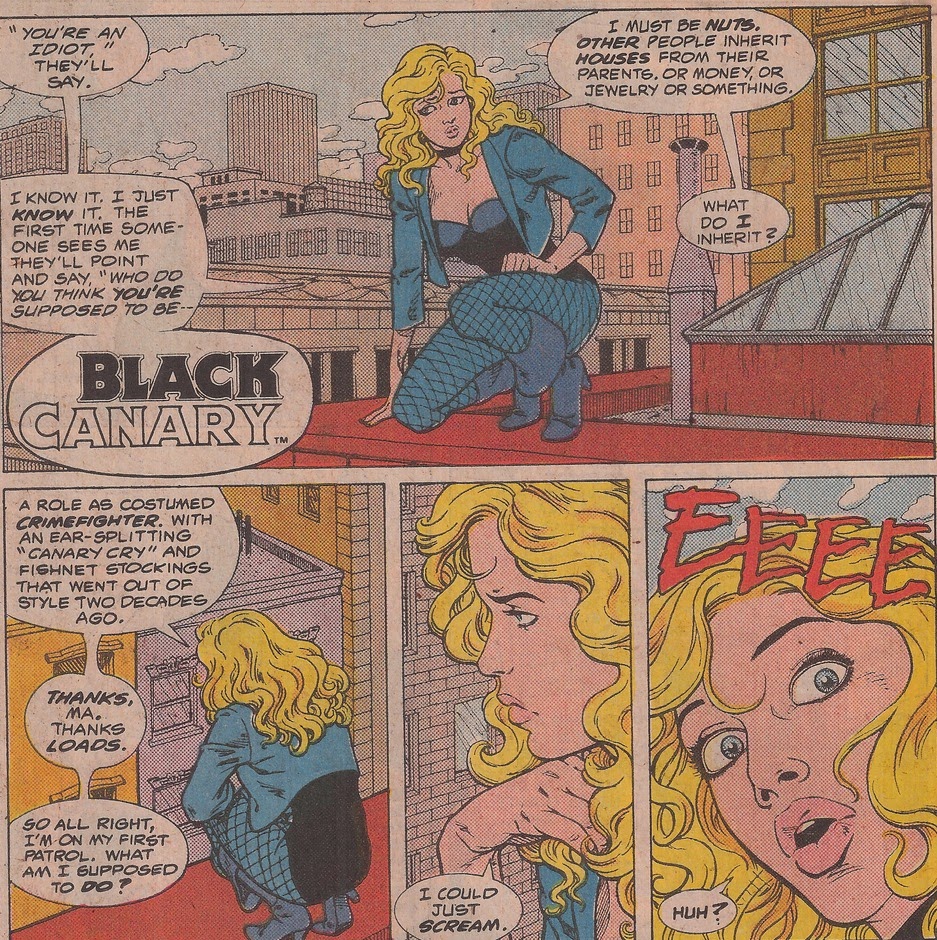
Elsewhere, a fledgling hero steps out one one of her first adventures.


Hearing the sound of a scream, Black Canary leaps into action, jumping from a fire escape to the alley before.  She sees someone harassing a woman and--taking a moment to deepen her voice so the perpetrator will take her seriously--demands the mugger surrender.

Except it's not a mugger; it's Glass Man, the third Appellaxian, who uses eye beams to turn people into glass.  The Glass Man tries to shoot Black Canary, but she dives out of the way.  Retreating to the street, she realizes that the monster has transformed even more people into glass.  Also, he's still coming for her.  She leaps away, but the Glass Man's gaze manages to turn one of her legs to glass.

The Appellaxian laughs at his prey, and that's enough to really piss her off.


Black Canary manages to get information about the meteor landing in the Everglades.  Black Canary speeds down to Florida in her car and sneaks past the police barricade.  She makes her way through the dense foliage, crossing her fingers that she doesn't ruin her fishnet stockings.  She spots the meteor... and something more.  A tree in humanoid shape speaking in an alien tongue.  When Black Canary approaches, she becomes frozen and demands the tree-person free her.  Now speaking in English, the tree-person says he is not responsible, that he is as much a prisoner as she.

Meanwhile, Hal Jordan, the Green Lantern of Space Sector 2814, returns to Earth after meeting the Guardians of the Universe and other members of the Green Lantern Corps for the first time.  This would put this story right after the events of Green Lantern #1 from 1960.


Hal's interest in the meteor picks up when he sees it suddenly change speed and direction.  Instead of burning up in Earth's atmosphere like a good meteor, this one crashes relatively safely in Africa.  Hal pursues the object in curiosity, while mulling over a few heroic catchphrases in his head.

From out of the meteorite comes the fourth Appellaxian contender in the shape of a giant yellow bird.  This Golden Roc fires eye beams that, just like the others, transform other people and creatures into beings not unlike itself.  Green Lantern's ring, of course, is useless against the color yellow but he dries some indirect attacks against the Golden Roc.  Faster than he expects the bird to move, it grabs Hal in its golden talons, and its touch begins changing Hal into a gold feathered creature.

Hal fires his ring into a cloud setting off a hail storm that distracts the Golden Roc enough that it lets Hal go.  Still in danger of changing, Green Lantern leads the big yellow bird on a chase into a waterfall.  When the Roc flies into the waterfall, Green Lantern freezes the water.  This destabilizes the Appellaxian's battle form enough that Hal and the other animals changed by the Roc revert back to their normal form.

After taking the animals to a zoo, Green Lantern realizes that more meteors have crash-landed on Earth.  He heads off toward the one meteorite believed to be unopened in the Florida Everglades.  When Hal arrives, voices from the woods try to warn him.

In England, the Flash had been meeting the Queen when he was asked to help put out some fires in the South London down of Croydon.  When the Flash arrives, he is shocked to see a Fire Giant, the fifth Appellaxian in a form that looks like, well, like a fire giant.  Barry Allen tries to blow out the Fire Giant by waving his arms at super-speed, but it only seems to embolden the Fire Giant.

The monster glares at Flash, which causes Flash to begin to transform into flame.  He immediately vibrates his molecular structure at the speed necessary to break the Fire Giant's connection.  Then Flash runs over to a standing body of water and circles it fast enough to suck up the water in a vortex and dump it on the Fire Giant.


When wind, water, and sand fail to extinguish the Fire Giant, Barry remembers the basic Flash Fact that fire requires oxygen to burn.  So he runs around the Fire Giant at such super-speed that he removes the oxygen from the surrounding air.  At last, the Appellaxian collapses, its battle form ruined.  The alien screams to unseen forces that he doesn't want his mind ripped from him, that he wants another chance.  Then he slumps over dead.

The Flash speaks to some of the Croydon citizens and one of them tells Flash about the other alien meteors arriving on Earth.  Flash runs across the Atlantic Ocean to arrive in the Everglades after the other heroes.  But when he arrives, he, like them, is transformed into a living tree.


The heroes banter for a short time and J'Onn tries to understand how they use humor to fend off terror.  Then the meteorite cracks open and the sixth Appellaxian steps out in the form of the Wood King.  This alien reveals to the heroes that he intentionally delayed his arrival, and now, thanks to Aquaman and the others (not that Aquaman and the Others), the alien only has one more contender to destroy before he can become Kalar of his home world.

The Wood King psychically commands the five heroes to follow him to Antarctica to battle the last Appellaxian.  Aquaman has no desire to walk from Florida to Antarctica, and little desire to serve as a tree soldier for the Wood King.  Using his own telepathic abilities, he is barely able to control his own physical body; it's not much, but it's enough to knock into Martian Manhunter who knocks into Green Lantern.  Using his own mental abilities, J'Onn is able to resist the Wood King's influence enough that he scrapes off the wood around Hal Jordan's ring.  Green Lantern only has enough will and aim to shine his ring's light on Black Canary's head, freeing her from the Wood King's power just temporarily.


Black Canary uses her Canary Cry on the Flash, pitching it at just the right frequency that it shatters the wood around his body, freeing the Fastest Man Alive.  The Flash launches himself at the Wood King with a volley of "a million high-speed punches".  He basically beats the Wood King to splinters, destroying the penultimate Appellaxian's battle form.


The five heroes agree to work together in bringing down the final Appellaxian.  Green Lantern and J'Onn J'Onzz fly, with Hal carrying Black Canary, Aquaman and the Flash in a bubble created by his ring.  During the journey south, Martian Manhunter notes that Green Lantern seems to be the only one completely at ease with an alien in their ranks.  Green Lantern, who just hours ago discovered he was part of an intergalactic peacekeeping force full of aliens, shares his first name, "Hal" to which the Manhunter from Mars says, "J'Onn."

When the group finds the meteorite in Antarctica, the Crystal Creature has already freed itself.  But it also ran afoul of Superman who has just destroyed the last Appellaxian.  The Man of Steel dusts off his hands and takes off, seemingly not noticing the heroes behind him (although with his super-senses, that seems nearly impossible).  The group is bummed out by their non-brush with celebrity and Black Canary mentions she was looking forward to working all together to fight the Crystal Creature.  "Safety in numbers," she says.  That lights up a bulb over Flash's head and he gets an idea.

Flash pitches the idea of working together as a team.  J'Onn is reluctant because it would require him to publicly out himself, but Barry counters that revealing himself in the context of joining other heroes would be good publicity for the Martian Manhunter--and for all of them.  Black Canary, as the youngest and least experienced of the group, says she loves the idea, that it would feel like a return of the old Justice Society of America.  Hal Jordan floats the team name Justice Society II, which gets shot down, and Barry floats the idea of The Avengers, but Dinah tells him they'll be confused by the TV show about British spies.

Finally they come to the name...


Within the clouds of future members of the Justice League of America are The Atom, Batman, Elongated Man, Firestorm, Green Arrow, Gypsy, Hawkgirl, Hawkman, Phantom Stranger, Red Tornado, Snapper Car, Steel, Vibe, Vixen, and Zatanna.  The notable absences are, of course, Superman who we saw earlier this issue and Wonder Woman, who we established was no longer part of the Justice League and wouldn't encounter the other heroes until the Legends miniseries event.

Peter David is one of the best writers in comics of the last twenty-five years so he's not going to script a crappy Justice League comic.  Keith Giffen and Mark Waid took Gardner Fox's decades-old story and fluffed it up a bit, and David added the right voices and little details that made the characters resonate so well.  With the exception of Aquaman being so down on himself, every character feels pretty right for the time.  J'Onn is a little paranoid of himself and stays hidden until he's encouraged by Green Lantern and the Flash.  Hal Jordan feels appropriately cocky given the weight of their situation, and Black Canary has the spitfire of a young woman looking to prove herself to her mother.

Eric Shanower's art is fan-freaking-tastic in this comic.  I've never really noticed his work before this issue, but it blew me away, particularly his rendering of human faces and expressions.  There's something similar to Mike Allred in how Shanower draws Aquaman and Hal Jordan, and most of his depictions of Black Canary are lovely and luscious.

So did I have any problems with this?  Well, not the issue so much as the effect Crisis on Infinite Earths had on the issue.  This may sound absurd coming from a guy who runs a Black Canary blog, but I don't think she should be a founding member of the Justice League of America.  I love Dinah, but she's not a heavyweight of that caliber.  Wonder Woman should always be one of the original members of the Justice League, as should Superman and Batman.  And their absence is noticeable in both this story and in JLA: Year One, the maxi series that serves as a sequel to this book.  In both of the stories, the League members seem a little rudderless; they lack leadership.  If Wonder Woman was part of this issue or Year One, the League would never feel leaderless.

Speaking of JLA: Year One, I suppose I should review that series sometime soon but there's a lot of other stuff I'm more excited about first.  Hopefully, before the year is over.

Wednesday, June 25, 2014

The Origin of Black Canary: 1990 - SECRET ORIGINS #50

I've read every Black Canary origin story that I'm aware exists, but none are more comprehensive, more definitive than the tale in Secret Origins.  That shouldn't surprise anyone.  That was the whole point of Secret Origins, to tell, retell, or even repair the origins of DC's greatest heroes and teams (except Aquaman).

Black Canary already had her origin story told by Gerry Conway in the late '70s.  Feeling the need to de-age the character in the '80s, however, Dinah's life story was radically altered by Roy Thomas in the pages of Justice League of America.  Thomas made Dinah Lance two different characters--mother and daughter--though the daughter was a blank slate imbued with her mother's memories, and thus, basically, a younger clone of her mother.  The Crisis on Infinite Earths that rocked DC's characters and continuity in the mid-'80s blessedly provided the perfect opportunity to clean up the spilled crazy of Roy Thomas' "fix".

It took the rest of the decade and the brilliance of Mark Waid, but the origin of Dinah Drake Lance and Dinah Laurel Lance was finally told in the series' final, extra-sized issue from June of 1990.


Secret Origin #50 featured six stories.  They knew the book was ending, so I guess the editorial team threw in everything they were working on.  The stories include a Dick Grayson prose story by Denny O'Neil with extra accompanying illustrations by George Perez.  There's a retelling of "The Flash of Two Worlds" written by Grant Morrison with art by Mike Parobeck and Romeo Tanghal.  The story of Johnny Thunder--that's the western hero, not the doofus with the genie that sponsored Dinah for JSA membership--that's by Elliot Maggin and Alan Weiss.  Though Aquaman was snubbed by the series, Dolphin gets a story Richard Bruning and Bove, and the final story in the final issue is none other than... the Space Museum by Gerard Jones with Carmine Infantino pencilling and George Perez inking.

Black Canary's story is the penultimate feature, and it's the real anchor of the issue, I believe.  The other five stories range between eight and fifteen pages.  Black Canary's story is twenty-four pages.  Yeah, two pages longer than an average comic of the time; four pages longer than a comic today.  This story could have been it's own issue, a one-shot maybe to test the waters for her miniseries that came out.

"Unfinished Business" was written by Alan Brennert with art by Joe Staton and Dick Giordano.  Todd Klein and Julia Lacquement lettered and colored the story respectively, and Michael Eury was the editor.  Mark Waid edited a lot of the tales in Secret Origins, and though he isn't credited as editor of this story, he is given a "Special Thanks To" nod the title page.  The general feeling is that he helped put all the disparate parts of Dinah's history together into one cohesive narrative that Alan Brennert fleshed out in his script.

Also of note, the story acknowledges the works of Robert Kanigher, Gardner Fox, Gerry Conway, Paul Levitz, Frank Miller, Mike Barr, Denny O'Neil, and Mike Grell.  Most of these creators had a hand in shaping Black Canary's history, and the others at least contributed to the DC Universe and the world Dinah inhabits.  There contributions will be reflected as I go through the story.

(Man, I think I wrote more to preface this story than I usually write for an entire review of a Chuck Dixon Birds of Prey issue... And more than Chuck Dixon used to write for a Birds of Prey script!)

So.  "Unfinished Business" opens with Dinah Laurel Lance in bed with Oliver Queen because all they ever did in the Mike Grell issues of Green Arrow was have or talk about sex.  Ollie is giving Dinah a deep back massage when the phone rings.  Dinah learns that her mother, Dinah Drake Lance, is in a coma in Gotham General Hospital.  The elder Dinah probably won't live through the night; her daughter, meanwhile, is frantic about being three-thousand miles away and helpless to get across the country before time runs out.

Ollie promises she'll get there on time and then makes a difficult phone call for him.  Next we see Green Lantern Hal Jordan has carried Dinah and Ollie to Gotham General using his power ring.  The ring is also able to scan Dinah Drake's vital signs and locate her room number.  Dinah Laurel rushes on ahead to see her mother while the Hard Traveling Heroes sort out their personal business.  Ollie thanks Hal for coming to help Dinah even after Ollie was such a sonofabitch when Hal needed him.  Hal points out that he's always been Dinah's friend, too, and Ollie goes on to apologize for being a dick before.


Hal flies off to locate someone else he thinks should be there with Dinah while reminding Ollie that no one can handle losing a parent.

When Ollie rejoins Dinah, she's meeting with her mom's attending physician, a doctor who claims to have interned with the original Dr. Mid-Nite and knows all bout Dinah's membership with the Justice Society of America.  He says Dinah, who has had cancer for some time, collapsed at her flower shop. Dinah Laurel remarks that the store was all her mom had after her husband died and she retired from crime fighting.

If the flower shop was all Dinah Drake had, that that doesn't speak highly of the relationship between mother and daughter.  When Dinah Laurel and Ollie go in to sit with the comatose Dinah Drake, the younger woman addresses this.  They didn't speak for years, and now they might never speak again.

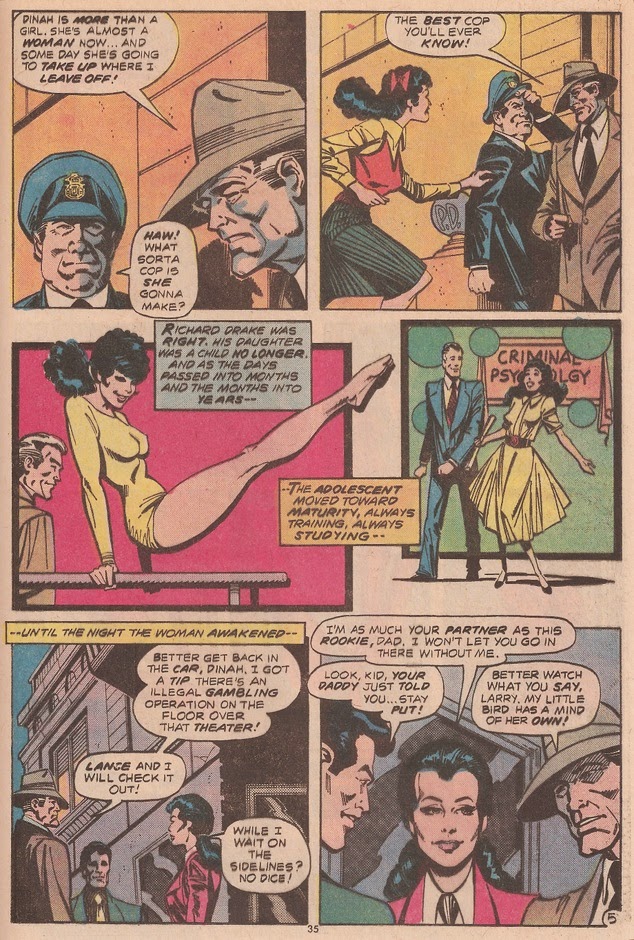
We then flashback to the days of Dinah Drake's youth.  A general omniscient narrator guides us through young Dinah growing up with her father, Detective Richard Drake of the Gotham City Police Force.


In 1947, just as Dinah was about to join the GCPD, she accompanies her father and his partner, Larry Lance, on a raid on a gambling den.  Richard Drake's informant told him the outfit was supposed to be smalltime and ill-equipped to handle the police.  Still, as a precaution, he tells Dinah to wait outside while he and Larry bust in.

Drake's tip was dead wrong about the gang's muscle.  He and Larry are severely outgunned and about to be killed when Dinah sneaks up behind the hoods and takes them out with her fancy judo moves.


This vignette is taken directly from the Black Canary origin written by Gerry Conway over a decade earlier.  What Alan Brennert adds to the story, though, is a more complicated reason for Dinah not being allowed onto the Gotham Police Force.  Instead of there being a moratorium on female police officers, Dinah is blacklisted as punishment for saving her father at the gambling den.  Brennert lays the foundation for Gotham's systemic corruption this early, that the Drakes embarrassed some mobbed-up politicians.  Richard Drake even suspects that he and Lance were lured into an ambush meant to kill them because his informant's tip was so wrong about the guns they'd be facing.  In the aftermath, and full of guilt, anger, and paranoia, Dinah's father suffers a fatal heart attack.

The dream of serving the police force may be over for Dinah, but not serving the cause of justice.


As Dinah cleans up the underworld as the costumed Black Canary, we see her open up the flower shop as the front for her civilian life.  We also hear that Larry Lance grew disillusioned with the police force and struck out on his own as a private investigator, and eventually, Dinah's lover.  We also see her teaming up with Johnny Thunder and the Thunderbolt, and her joining the legendary heroes of the Justice Society of America.  The details of Black Canary's early adventures come from the Golden Age tales written by her creator, Robert Kanigher, and her membership with the JSA was originally penned by Gardner Fox.

We then see the Justice Society going up against HUAC, as told by Paul Levitz in "The Defeat of the Justice Society" in Adventure Comics #466.  The JSA disbands and Black Canary returns to civilian life.  She marries Larry Lance and becomes his partner in Lance & Lance Private Detectives.  While she and Larry continue to fight injustice in civilian life, she learns more and more how dirty Gotham City has become.

Crime in Gotham becomes so rampant that before long, a new costumed vigilante steps in to combat it.  No... not that vigilante... not yet.  First is The Reaper, the skull-masked villain with two scythe gloves from Batman: Year Two.  He's going around killing bad guys while former Green Lantern Alan Scott tries to call attention to this extremism with his radio show.  That's not enough, though, and after a while, Alan Scott becomes the Green Lantern once more.

Scott catches the Reaper one night and uses the power of his ring to disarm and nearly detain the killer.  In desperation, the Reaper flings a pair of wooden nunchucks at Alan.  The wood passes through the Green Lantern's forcefield and strikes him in the head, nearly killing him.  The rest of the former JSAers rally to Alan Scott and the hospital and put on their costumes once more to avenge their friend.

Judson Caspian, the Reaper, was created by Mike Barr for the "Year Two" story in Detective Comics #575-578.  That's really all he ever appeared in and there was nothing to do with Black Canary, Green Lantern, or the Justice Society of America in his story.  That's all a retcon by Brennert, but it does layer the histories that he's joining together and making the world more interconnected.

Dinah Drake Lance, we find out, was not among the heroes to return to costumed crime fighting.  She and Larry moved to the suburbs and had a daughter, Dinah Laurel Lance, who grew up with the most amazing "extended family" you could ever imagine.


Dinah Drake forbids her daughter from growing up to be a costumed hero like her.  She tells Dinah Laurel that the world has grown too dark and too dangerous for any normal human to fight crime without superpowers.

The appearance of Batman in Gotham City begs to differ.  Speaking of Batman, there's never really a scene or story thread that directly references Frank Miller's work, despite him being acknowledged with other creators at the top.  Names from "Year One" like Commissioner Loeb and Carmine Falcone are dropped from time to time when the story talks about how awful life in Gotham is, but that's it.

A few years later, Dinah Laurel is training at her Uncle Ted Grant's gym.  Her sparring partner is Yolanda Montez, who would become the second Wildcat and a member of Infinity, Inc. after Ted  appeared to perish.  Dinah talks to Ted and we learn that this fight training is a secret kept from her mother.  Ted tells Dinah Laurel that her mother is right to be worried about the bleakness of the world they live in now.


Ted then recounts a heartbreaking story about getting his girlfriend Irina pregnant.  They eventually had a son named Jake, but one of Wildcat's forgettable Golden Age villains, Yellow Wasp, learned about Jake's existence and kidnapped the boy.  Ted never found his son.  He asks Dinah Laurel one more time if this is the kind of life she wants to get involved in, but her resolve is as steely as ever.

As far as I've been able to ascertain, the situation with Ted's kidnapped son never existed before this story.  The Yellow Wasp only made a few appearances in the Golden Age and nothing about Jake was ever explored until a decade after this issue.  This story, I assume, was created by Brennert or Mark Waid, but not, I suspect, entirely out of nowhere.

The touch of a villain breaking into the hero's home and targeting an infant child mirrors the story of the Wizard attacking and cursing the infant Dinah Laurel from the revised origin in Justice League of America #220 by Roy Thomas.  That attack explained the younger Dinah's "Canary Cry" and the separation from her family for twenty years.  That bit of retroactive continuity will not be used in this latest origin story, but Brennert and Waid found a way to use the same idea in a different way.

So what does cause Dinah Laurel's sonic scream?  Well, it first manifests when she's a teenager fighting with her mother.  Mom learned that her girl was training behind her back and the two of them shout at each other about trust and violating trust and after a while Dinah Laurel bursts with teenage girl angst.


Wait, is her power the result of metahuman genetics?  Or magic?  Or "mystic radiation"?  And is it Green Lantern's fault?!!  That much is unexplained, and honestly, who cares where it comes from?  Because next we see Dinah Laurel Lance has taken on her mother's former guise as Black Canary and joined the new generation of heroes.


We then get a rapid succession of the new Black Canary's early adventures, such as falling in love with Green Arrow; mothering Ollie's sidekick, Roy Harper, as he fights heroin addiction; and lying in bed with Ollie, telling him she doesn't want kids of her own.  We also glimpse one of the annual team-ups of the Justice League and Justice Society, as well as the ill-fated battle against Aquarius that cost Larry Lance his life.  These story beats directly reference moments originally told by Denny O'Neil and Mike Grell.

At last the flashbacks of old and young Black Canaries are over and we return to Dinah Laurel and Ollie in the waiting room of Gotham General.  She tells Ollie that her mother never recovered from Larry's death, that she begged Dinah Laurel to hang up the fishnets because the superhero life would cost her everything she loves.

Hal Jordan returns, and he's brought Roy Harper with him.  Roy reminds Dinah that she was there to take care of him when he was at his lowest; the least he could do was return the favor.  Dinah remarks that when her mother died, it will be the end of an era.  She's the last Justice Society member left after the others went on to Ragnarok in Last Days of the Justice Society.  Hal tells Ollie that he failed to track down the veteran heroes, and after speaking with Doctor Fate, his heart aches that they're "not even resting in peace."

The doctor tells Dinah that her mother's vitals are fading and there isn't much time left.  Dinah Laurel and her friends gather around Dinah Drake.  No one expects the elder Dinah to wake up or speak, but that's exactly what happens after an invisible hand reaches out from another plane and touches her.

Dinah Drake regains consciousness long enough to ask for her daughter's forgiveness.  She spent too much of their lives fighting about Dinah Laurel following in her footsteps.  Dinah Drake was so full of anguish after Larry died, and so full of guilt after her daughter was tortured in The Longbow Hunters.  The dying Dinah reveals that the cancer eating away at her was caused by the same power that killed her husband, that the radiation merely took longer to finish her.  She admits to being grateful that she's not just another cancer death, and wonders how arrogant that sounds (pretty arrogant).

The last thing she tells her daughter is she loves her and asks Ollie to take care of her.  Then she passes away and her spirit is greeted... and comforted... by The Spectre.


Whew... At twenty-four pages, this is a deep, dense story.  I said upfront that this origin was comprehensive.  It covers the lives, the exploits, and the tragedies of two different women.  And in between we get little side-stories of Alan Scott and Ted Grant.  Brennert's script manages to take enrich already great ideas and make sense of truly kooky concepts.

Selfishly, I'll admit I like Conway's origin from '78 more.  It's just simpler and straightforward because he was only dealing with one character not a legacy, and he didn't have to clean up other writers' crazy ideas.  Also, the concept of the tomboy raised by her cop dad wanting to be cop but turning into a costumed superhero is just classically beautiful, which is why it's been used for both Batgirl and Batwoman.

This is a pretty damn awesome story, though, from the framing device of a parent's passing, to the parallel tracks of childhood maturity--one driven to please her father, one driven to defy her mother.  Dick Giordano was inking just about everything related to Green Arrow and Black Canary in the late 1980s and early '90s.  He does a solid job of handling Joe Staton, who gave subtle alterations to the flavor of this book by casting the flashbacks with more angles and expression.

I don't know if there will ever be a Black Canary origin as flush with iconic moments and original bits as this one.  If there ever needs to be, something has gone wrong.

Thursday, April 10, 2014

The Origin of Black Canary: 1983 Part 2 - JUSTICE LEAGUE OF AMERICA #220

I've waited months to review Justice League of America #220, a story that radically reimagines not only Black Canary's history but her whole identity and status as a member of both the Justice League of Earth 1 and the Justice Society of Earth 2.  At last, the time is right to cover this story, because according to the 1976 Super DC Calendar, today, April 10th, is Black Canary's birthday.


Justice League of America #220: "The Doppelgänger Gambit" is written by Roy Thomas with pencil art by Chuck Patton and inks by Romeo Tanghal and Pablo Marcos.  George Perez delivers a cover with not one but two Black Canaries--one corpse-like in a casket beside the late Larry Lance, and the other looking on in horror with members of the Justice Society of America, Red Tornado and Sargon the Sorcerer, all while the Earth 1 Johnny Thunder and the Thunderbolt loom menacingly.  The cover boasts that this issue includes the "true origin of the Black Canary".

Gerry Conway already wrote an amazing origin story for Black Canary with only one noticeable problem that I can see: it dated her.  Conway's story specifically locked Dinah into an era that was becoming evermore recognizable as the past.  The Justice League members were supposed to be young and in their prime, but the math would make Black Canary out to be something like sixty-two years old.

DC needed a retcon to explain this age discrepancy so that Black Canary could have functioned in both eras, on both teams, without qualifying for an AARP card.  And in the late 1980s they would write that retcon and it would work wonders.  But before they got there, Roy Thomas would craft a Black Canary origin story (supposedly inspired by a Marv Wolfman idea) that would make even Hawkman's history look straightforward.

Last time, for reasons unknown and inexplicable to characters who know him, Johnny Thunder's genie-like Thunderbolt attacked the Justice League of America during its annual meeting with the Justice Society.  Barry Allen, Hal Jordan, Firestorm, Elongated Man, and Zatanna were struck down by the mad Thunderbolt and now lie comatose in the JLA Satellite.  Only Black Canary and Red Tornado, both of whom originated from Earth 2, as well as Justice Society members Jay Garrick, Power Girl, Huntress, Hourman, and Starman came through the battle relatively unscathed.

Almost immediately after the attack, pairs of super villains from both worlds launched attacks against ancient temples of worship.  While Starman took Black Canary to the Thunderbolt Dimension to investigate the Johnny Thunder connection, the JSA members went planet side to take on the villains.


Power Girl shows her eagerness to tackle the villains, while Red Tornado advises caution and a strategy session to plan their counterstrike.  (Red Tornado is the worst.)  The unexpected arrival of Sargon the Sorcerer prompts half of the JSA to lash out at the mage.  Sargon mildly flirts with Huntress while magically besting her, Power Girl and Red Tornado, who, seriously, is the worst.

Sargon tells the Flash and Hourman that he was working with the Spectre when the Thunderbolt struck him down in his Earth 1 human host, Jim Corrigan.  The Flash welcomes Sargon's help and sends him out with Power Girl, who sounds less than thrilled.


In the Thunderbolt Dimension, Black Canary and Starman were captured, not by the Johnny Thunder they suspected--the Johnny Black Canary befriended in her very first published adventures--but the Johnny Thunder of Earth 1.  This Johnny Thunder is crazy and vengeful and he's taken control of the Thunderolt.

But far more shocking than their enemy's identity is what he shows them: a glass casket with the bodies of Black Canary's late husband, Larry Lance, and another body that looks exactly like her.  Johnny also holds captive the original and noble Johnny Thunder of Earth 2.

At Evil Johnny's command, Thunderbolt tells the story of how he and Good Johnny fought crime in the '40s on Earth 2, how Black Canary joined them in their crusade for justice, and how Thunderbolt was injured during one of their adventures, explaining why Johnny Thunder's monthly adventures went away in favor of Dinah's solo stories.


Good Johnny took off, devastated that the woman he fell in love with favored Larry Lance over him.  In subsequent years, he stayed out of her life while she grew closer to both Larry and the Justice Society.  Until, of course, the day the Justice Society of America quit fighting crime by refusing to divulge their real identities before Congress.


The Wizard... "the greatest super criminal in the history of the planet"?!!  That's a helluva stretch, but I will concede after this story he might be Black Canary's greatest villain.  Maybe.


A desperate Dinah and Larry Lance bring their infant baby to Johnny Thunder, who summons Thunderbolt.  The genie offers to take the baby to the Thunderbolt Dimension where her destructive sonic powers won't harm anyone.  The caveat being, of course, that once there the child can never leave.  If Dinah and Larry send their child with Thunderbolt, she'll be safe, but they'll never see her again.

Approximately ten years after this story is published, the X-Men's Cyclops and Jean Grey would face a similar dilemma when their infant was infected with a virus and needed to be sent into the future to save his life, resulting in their child becoming the militaristic leader of X-Force, Cable.  And that scenario makes only a little bit more sense than what Roy Thomas will offer up later in this issue.

Dinah and Larry agonize over the decision--I would think--but finally surrender their baby to the protection of Thunderbolt.  He brings the baby to the Thunderbolt Dimension and keeps her in suspended animation, but then he goes a little off-script and wipes the memory from Dinah, Larry, and Johnny Thunder.  He convinces them that the baby died... because it will be easier for them to deal with...  Yep.

Black Canary, much like any attentive reader, is full of questions.  But Evil Johnny interrupts the story to draw attention to the ensuing battles on Earth 1 between the heroic and villainous pairings.

In Mexico, Chronos and the Fiddler have seized an ancient pyramid.  Jay Garrick and Hourman rush to intervene but they're thwarted by a time-holograph created by Chronos, and then the Fiddler plays a little ditty causing the heroes to keep dancing until they die.

Meanwhile, Dr. Alchemy and the Icicle have taken over one of the Great Pyramids of Egypt when Huntress and Red Tornado come liberate the place.  Reddy drops Huntress off on the sloping face of the pyramid, but Icicle freezes the side, causing Huntress to slide down.  But being the daughter of Batman and Catwoman affords Huntress a healthy amount of agility and preparedness.  She manages to throw a batarang that knocks out Icicle even as she's sliding down.


At the same time, Red Tornado is battling Dr. Alchemy, who maneuvers the android into position so that Huntress slides off the pyramid and crashes right into him.  The result is that Huntress and Red Tornado are both knocked out, spoiling all of the good will Huntress gained by swatting Icicle.  God, Red Tornado sucks.

And at Stonehenge, we find the last duo, Power Girl and Sargon squaring off against the wicked mages, Felix Faust and the Wizard.  The bad guys use their magic to fool Power Girl and Sargon into striking each other, knocking each other unconscious.  Then, naturally, Wizard and Faust bicker amongst each other, because that's what villains do.

Back in the Thunderbolt Dimension, Evil Johnny taunts his hostages and brags of the devious goings-on that he's fostered down on Earth 1.  Unbeknownst to Evil Johnny, some of the electric sprites of the dimension have come to started rescuing Good Johnny from his bonds.  Just when Evil Johnny is ordering the genie to murder Black Canary and Starman, Good Johnny breaks free and shouts out the magic words that put Thunderbolt back in control.


Freed of Evil Johnny's influence, Thunderbolt races to the JLA Satellite to revive the Leaguers he hurt last issue.  And before long, the heroes of Earth 1 snap back into action.


Elongated Man and Barry Allen help Jay and Hourman take out Chronos and the Fiddler.  Firestorm and Hal Jordan help Huntress and Red Tornado take out Dr. Alchemy and the Icicle.   And Zatanna helps Power Girl and Sargon take out Felix Faust and the Wizard.

In the Thunderbolt Dimension, Evil Johnny is captured though still trying to regain control over the genie.  Black Canary is overwhelmed by the image of what looks like herself and her dead husband.  Is it a daughter she never knew or something even stranger, she wonders.

Oh, it's stranger.  And it's the kind of story that only Bob Haney Superman and the Spectre could tell.


So... Superman thought it best that Black Canary swap bodies and memories with her own daughter who lived a decades in suspended animation.  Dinah Drake effectively dies with her husband, while her consciousness takes over the dormant body of her daughter.


Aside from Red Tornado totally being the worst, what can we gather from this issue?

This ending is so, sooooo $@#%ed up!  I guess at this point Black Canary is considered to be the daughter of the original Black Canary, but she's full of her mother's memories and experiences.  What happens to her now will shape her life as though she's a different person, but couldn't that be said of any character.

The whole motive for this retcon was to de-age Black Canary.  And Roy Thomas did so by putting the character in the identical body of a child she never remembered having.  But the tale ends with her crying and being carried off--happily--in Superman's arms, so I guess it's a wash.  After all, that's how issue #74 ended when her husband died right in front of her.  Maybe that's one of Superman's untapped powers; he can make Black Canary get over any traumatic event.

The action scenes with the Justice Society versus the dastardly duos is mostly underwhelming.  The way the heroes fail to stop their adversaries is forced and lame, but the timely arrival of the Justice League heroes is pretty exciting.

Black Canary has never had much of a Rogues' Gallery; her list of personal foes makes Aquaman's look like the Society of Evil.  This story, however, puts two common foes of the JSA and JLA firmly in Dinah's stack of super villains.  Johnny Thunder of Earth 1 never achieved much on the page or off, but his schemes and his connection to her personal history make him an interesting enemy for later stories.  Likewise, Black Canary now has a personal, maybe the most personal beef with the Wizard.  He cursed her own freaking child and condemned it to suspended animation for life until she took over the body.

Well, Happy Birthday, Black Canary!  You get a new body and a new history, one that will last about five years before cooler heads think of a better idea for post-Crisis on Infinite Earths.

Thursday, April 3, 2014

The Origin of Black Canary: 1983 Part 1 - JUSTICE LEAGUE OF AMERICA #219

Because I can't help myself when it comes to these little segues, today, April 3rd, is the birthday of the original Flash, Jay Garrick, at least according to the Super DC Calendar from 1976.  That's why I've saved my reviews of Justice League of America #219-220 until now.  The story spanning these issues doesn't just radically revise Black Canary's origin, but also prominently features Jay Garrick and the Justice Society of America.


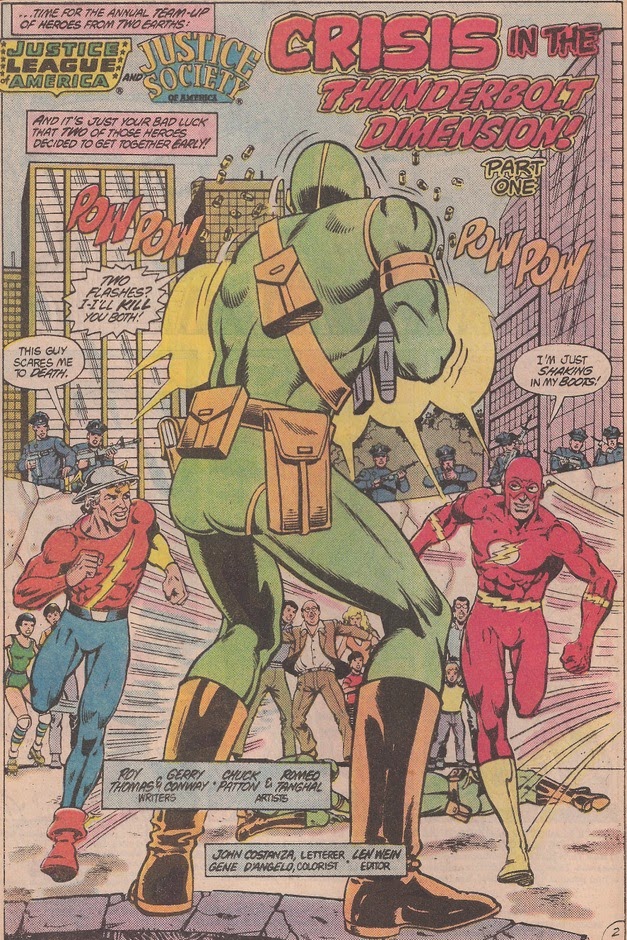
Justice League of America #219: "Crisis in the Thunderbolt Dimension" is cowritten by series regular Gerry Conway along with Roy Thomas, who'd been writing All-Star Squadron at the time and pretty much owned anything related to the Golden Age heroes.  Pencils and inks on the issue are provided by Chuck Patton and Romeo Tanghal respectively.  The cover, depicting a familiar-looking genie called Thunderbolt attacking the Justice League while their Earth 2 counterparts look on in horror, is drawn by none other than George Perez.  The story came out in October of 1983.

The story begins with a group of heavily armed terrorists taking hostages in a public park in Central City.  While the terrorist leader announces their demands to the police, however, an unseen force begins taking down his cronies and henchmen.  See, in all their scheming, this group didn't count on two scarlet speedsters to interfere with their plans.

Both Barry Allen and Jay Garrick, each known as The Flash, the Fastest Man Alive in their worlds, race into action in a title page that pays homage to the original Flash of Two Worlds story.


Jay and Barry take turns redirecting the terrorist's machine-gun spray so that it spells JSA and JLA on the wall.  The Central City spectators and police are a bit slow to recognize Jay, who they mostly know as a fictional superhero appearing in Flash Comics.  'Cause, y'know, that made sense at the time.

After saving the day, the Flashes run to the Justice League Satellite transporter.  Jay lends voice to a concern that I've had for years about the proper naming for Earths 1 and 2.


As they speed up the side of the building and prepare to teleport to the League's orbital headquarters, the two reflect on their annual meetings and how enjoyable it is for them.  However, as they're about to leave, the weather abruptly turns stormy.  And a crackling spike of pink lighting arcs down from the sky toward the speedsters.

Jay recognizes the energy source too late.  The lightning grazes him but turns its full force on Barry.  Even the Flash of Earth 1 can't outrun the bolt that seems to strike him dead.


The Thunderbolt gives no reply.  Jay tries to attack, but it effortlessly knocks him back with a low-level blast.  He looks up just in time to see the Thunderbolt fade away.  Jay crawls over to examine Barry and finds the other Flash barely clinging to life.

Desperate, Jay knows he must get Barry up to the satellite, currently orbiting the Earth at a distance of 22,300 miles above the surface.  There the combined members of the Justice League and Justice Society of America mingle like friends at a company picnic.


I love Black Canary's half-conversation with Huntress and Power Girl.  There's so much innuendo delivered in her line before Power Girl clears up the matter.  And speaking of Power Girl, Firestorm is pining over her like a classic teenager with a crush.  And why wouldn't he?  It's Power Girl!

Green Lantern and Starman talk about boring cosmic stuff, while Elongated Man pulls Firestorm aside so that he, Zatanna, and Hourman can give the kid some dating advice.  Unfortunately, just before Firestorm asks Power Girl to visit the Trophy Room (wink wink), the frivolity is spoiled by the pink lightning bolt crashing into the room.

Black Canary and Starman recognize the energy signature of the lightning bolt, but Firestorm doesn't much care.  Unwilling to be ****-blocked by a light show, the Nuclear Man rushes to confront the lightning.  It promptly shocks him, knocking the life out of him.  Then the lightning takes the familiar form of Johnny Thunder's genie, the Thunderbolt.

Hourman pops a pill and charges the Thunderbolt with his newfound super-strength, but is easily batted away.  Green Lantern attacks with his Power Ring and Starman with his Cosmic Rod (wink wink, wait, that's not a euphemism!)  Thunderbolt absorbs the energy and redirects it, striking Green Lantern with all the power.  The Thunderbolt next turns its attention on Red Tornado, knocking the android across the room, demolishing some of the satellite's dimensional transporter in the process.  It strikes at Power Girl, Elongated Man, and Zatanna before the Mistress of Magic can cast a spell against it.


As the heroes still standing check on their wounded and ask questions, the transporter tube opens to reveal Jay Garrick carrying the unconscious Barry Allen.  The Flash, Green Lantern, Zatanna, Firestorm, and Elongated Man are all taken to the medi-lab, where they remain in critical condition.  It doesn't take long for the survivors to realize what they all have in common: Black Canary, Power Girl, Huntress, Hourman, Starman, and Jay Garrick were all born on Earth 2, and Red Tornado was first assembled there.  The next question, of course, is why does that matter?

For newer readers who might have thought Black Canary was always a native Leaguer, she recounts her story of coming to Earth 1.  It started when Starman crashed through the roof her home with Larry Lance, her husband on Earth 2.


Dinah goes on to remember how on her first day with the Justice League she let slip a tremendous blast of sonic energy.  Batman had explained that her proximity to Aquarius' energy when Larry died and mutated her, granting her a new metahuman power, her Canary Cry.  Dinah admits that Batman's explanation never quite made sense to her (or to Gerry Conway and Roy Thomas, I'd bet).

While she's daydreaming about the past, Power Girl and Red Tornado use the satellite's surveillance equipment to confirm that Superman and Wonder Woman have also been rendered unconscious by the Thunderbolt, and Aquaman, Green Arrow, Hawkman and Hawkgirl may also have been taken out like the other League members.

Huntress speculates that the problem might not emanate from a rogue Thunderbolt but from Johnny Thunder himself.  Black Canary refuses to believe her old friend could have betrayed them like this.  At that point, Power Girl reveals that pairs of super villains from both Earths are attacking ancient temples on the planet below.  From Earth 1, Chronos, Dr. Alchemy, and Felix Faust are each partnered with The Fiddler, Icicle, and the Wizard from Earth 2.

The heroes speculate that these combined villains are behind the Thunderbolt's attack on the League.  They quickly jump into action.


I'm going to say it right here, a big part of me has and always will prefer Black Canary and Starman as a couple over Black Canary and Green Arrow.  That these two had a brief but passionate affair was the best retcon James Robinson ever contributed to the DC Universe.  I just love the way these two interact, and you can see the love Ted has for her in the last panel.

Black Canary agrees to Starman's plan to track the Thunderbolt and get answers directly from the source of their problem.  He uses his Cosmic Rod (tee-hee) to transport them through space and into the alternate dimension of the genie: the Thunderbolt Dimension!

While struggling to get their bearings in the topsy-turvy alternate world, they spy someone watching them from a lofty throne.  Before they can react, the Thunderbolt attacks Starman.  Black Canary lets loose a sonic cry, but it has no effect on the genie this time.  Dinah is immobilized and the two are brought before their captor: the Johnny Thunder of Earth 1!


What's with the glass coffin holding Larry Lance and a double of Black Canary?!!  I guess you'll have to wait until next Thursday for my review of issue #220.

This is a great issue, and as one of the annual crossovers with the Golden Age heroes of Earth 2, it's a real treat to see characters like Jay Garrick, Hourman, and Starman get such a worthy place in the story.  True it's at the expense of the titular members of the Justice League, but even they get moments to shine, however briefly.  Everyone gets to use his or her power, mostly to little effect, but it still looks cool.

But naturally my favorite part of the story is the emphasis on Black Canary's pre-League roots.  She originally debuted in the Johnny Thunder strip in Flash Comics, so it's thrilling to see that history play out as her friends are stalked by Johnny Thunder's wayward djinn.  Everyone questions the culpability of Johnny Thunder, but Dinah refuses to believe her old friend could have gone bad like this.  It is more dramatic and powerful then at the end when she learns that a Johnny Thunder is behind her woes, just not the Johnny everyone suspected.

Conway and Thomas' script is impeccable in this issue, filled with nice character beats, like the dialogue between the Flashes and the cops in the first scene; and Firestorm's angst over Power Girl; and Starman coming to Black Canary alone, giving her a chance to resolve this personal conflict for herself.  All perfect moments.  Patton and Tanghal's art, too, is beautiful.  The tension and terror on the characters' face have never seemed so dramatic.  Brilliant stuff here.

In the end, though, this issue is mostly a set-up for the greatness--and wonkiness--that will come with issue #220.  That issue is full of a ton of action and a whole new origin story for Black Canary.  Come back in a week to check out my review!