I've read every Black Canary origin story that I'm aware exists, but none are more comprehensive, more
definitive than the tale in
Secret Origins. That shouldn't surprise anyone. That was the whole point of Secret Origins, to tell, retell, or even repair the origins of DC's greatest heroes and teams (except Aquaman).
Black Canary already had
her origin story told by Gerry Conway in the late '70s. Feeling the need to de-age the character in the '80s, however, Dinah's life story was
radically altered by Roy Thomas in the pages of
Justice League of America. Thomas made Dinah Lance two different characters--mother and daughter--though the daughter was a blank slate imbued with her mother's memories, and thus, basically, a younger clone of her mother. The
Crisis on Infinite Earths that rocked DC's characters and continuity in the mid-'80s blessedly provided the perfect opportunity to clean up the spilled crazy of Roy Thomas' "fix".
It took the rest of the decade and the brilliance of Mark Waid, but the origin of Dinah Drake Lance and Dinah Laurel Lance was finally told in the series' final, extra-sized issue from June of 1990.

Secret Origin #50 featured six stories. They knew the book was ending, so I guess the editorial team threw in everything they were working on. The stories include a Dick Grayson prose story by Denny O'Neil with extra accompanying illustrations by George Perez. There's a retelling of "The Flash of Two Worlds" written by Grant Morrison with art by Mike Parobeck and Romeo Tanghal. The story of Johnny Thunder--that's the western hero, not the doofus with the genie that sponsored Dinah for JSA membership--that's by Elliot Maggin and Alan Weiss. Though Aquaman was snubbed by the series, Dolphin gets a story Richard Bruning and Bove, and the final story in the final issue is none other than... the Space Museum by Gerard Jones with Carmine Infantino pencilling and George Perez inking.
Black Canary's story is the penultimate feature, and it's the real anchor of the issue, I believe. The other five stories range between eight and fifteen pages. Black Canary's story is twenty-four pages. Yeah, two pages longer than an average comic of the time; four pages longer than a comic today. This story could have been it's own issue, a one-shot maybe to test the waters for her miniseries that came out.
"Unfinished Business" was written by Alan Brennert with art by Joe Staton and Dick Giordano. Todd Klein and Julia Lacquement lettered and colored the story respectively, and Michael Eury was the editor. Mark Waid edited a lot of the tales in Secret Origins, and though he isn't credited as editor of this story, he is given a "Special Thanks To" nod the title page. The general feeling is that he helped put all the disparate parts of Dinah's history together into one cohesive narrative that Alan Brennert fleshed out in his script.
Also of note, the story acknowledges the works of Robert Kanigher, Gardner Fox, Gerry Conway, Paul Levitz, Frank Miller, Mike Barr, Denny O'Neil, and Mike Grell. Most of these creators had a hand in shaping Black Canary's history, and the others at least contributed to the DC Universe and the world Dinah inhabits. There contributions will be reflected as I go through the story.
(Man, I think I wrote more to preface this story than I usually write for an entire review of a Chuck Dixon Birds of Prey issue... And more than Chuck Dixon used to write for a Birds of Prey script!)
So. "Unfinished Business" opens with Dinah Laurel Lance in bed with Oliver Queen because all they ever did in the Mike Grell issues of Green Arrow was have or talk about sex. Ollie is giving Dinah a deep back massage when the phone rings. Dinah learns that her mother, Dinah Drake Lance, is in a coma in Gotham General Hospital. The elder Dinah probably won't live through the night; her daughter, meanwhile, is frantic about being three-thousand miles away and helpless to get across the country before time runs out.
Ollie promises she'll get there on time and then makes a difficult phone call for him. Next we see Green Lantern Hal Jordan has carried Dinah and Ollie to Gotham General using his power ring. The ring is also able to scan Dinah Drake's vital signs and locate her room number. Dinah Laurel rushes on ahead to see her mother while the Hard Traveling Heroes sort out their personal business. Ollie thanks Hal for coming to help Dinah even after Ollie was such a sonofabitch when Hal needed him. Hal points out that he's always been Dinah's friend, too, and Ollie goes on to apologize for being a dick before.
Hal flies off to locate someone else he thinks should be there with Dinah while reminding Ollie that no one can handle losing a parent.
When Ollie rejoins Dinah, she's meeting with her mom's attending physician, a doctor who claims to have interned with the original Dr. Mid-Nite and knows all bout Dinah's membership with the Justice Society of America. He says Dinah, who has had cancer for some time, collapsed at her flower shop. Dinah Laurel remarks that the store was all her mom had after her husband died and she retired from crime fighting.
If the flower shop was all Dinah Drake had, that that doesn't speak highly of the relationship between mother and daughter. When Dinah Laurel and Ollie go in to sit with the comatose Dinah Drake, the younger woman addresses this. They didn't speak for years, and now they might never speak again.
We then flashback to the days of Dinah Drake's youth. A general omniscient narrator guides us through young Dinah growing up with her father, Detective Richard Drake of the Gotham City Police Force.
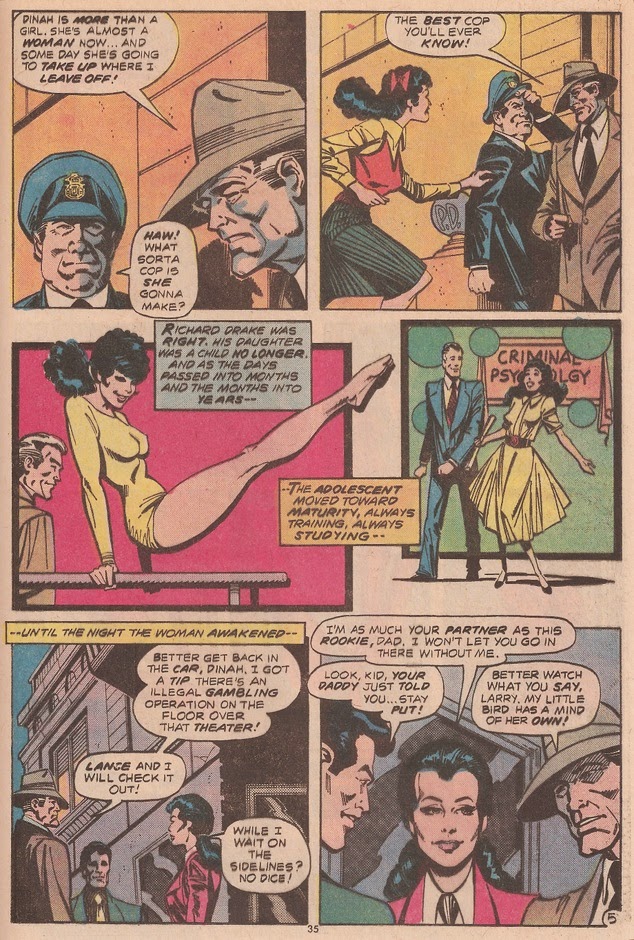
In 1947, just as Dinah was about to join the GCPD, she accompanies her father and his partner, Larry Lance, on a raid on a gambling den. Richard Drake's informant told him the outfit was supposed to be smalltime and ill-equipped to handle the police. Still, as a precaution, he tells Dinah to wait outside while he and Larry bust in.
Drake's tip was dead wrong about the gang's muscle. He and Larry are severely outgunned and about to be killed when Dinah sneaks up behind the hoods and takes them out with her fancy judo moves.
This vignette is taken directly from the Black Canary origin written by Gerry Conway over a decade earlier. What Alan Brennert adds to the story, though, is a more complicated reason for Dinah not being allowed onto the Gotham Police Force. Instead of there being a moratorium on female police officers, Dinah is blacklisted as punishment for saving her father at the gambling den. Brennert lays the foundation for Gotham's systemic corruption this early, that the Drakes embarrassed some mobbed-up politicians. Richard Drake even suspects that he and Lance were lured into an ambush meant to kill them because his informant's tip was so wrong about the guns they'd be facing. In the aftermath, and full of guilt, anger, and paranoia, Dinah's father suffers a fatal heart attack.
The dream of serving the police force may be over for Dinah, but not serving the cause of justice.
As Dinah cleans up the underworld as the costumed Black Canary, we see her open up the flower shop as the front for her civilian life. We also hear that Larry Lance grew disillusioned with the police force and struck out on his own as a private investigator, and eventually, Dinah's lover. We also see her teaming up with Johnny Thunder and the Thunderbolt, and her joining the legendary heroes of the Justice Society of America. The details of Black Canary's early adventures come from the Golden Age tales written by her creator, Robert Kanigher, and her membership with the JSA was originally penned by Gardner Fox.
We then see the Justice Society going up against HUAC, as told by Paul Levitz in "The Defeat of the Justice Society" in Adventure Comics #466. The JSA disbands and Black Canary returns to civilian life. She marries Larry Lance and becomes his partner in Lance & Lance Private Detectives. While she and Larry continue to fight injustice in civilian life, she learns more and more how dirty Gotham City has become.
Crime in Gotham becomes so rampant that before long, a new costumed vigilante steps in to combat it. No... not that vigilante... not yet. First is The Reaper, the skull-masked villain with two scythe gloves from Batman: Year Two. He's going around killing bad guys while former Green Lantern Alan Scott tries to call attention to this extremism with his radio show. That's not enough, though, and after a while, Alan Scott becomes the Green Lantern once more.
Scott catches the Reaper one night and uses the power of his ring to disarm and nearly detain the killer. In desperation, the Reaper flings a pair of wooden nunchucks at Alan. The wood passes through the Green Lantern's forcefield and strikes him in the head, nearly killing him. The rest of the former JSAers rally to Alan Scott and the hospital and put on their costumes once more to avenge their friend.
Judson Caspian, the Reaper, was created by Mike Barr for the "Year Two" story in Detective Comics #575-578. That's really all he ever appeared in and there was nothing to do with Black Canary, Green Lantern, or the Justice Society of America in his story. That's all a retcon by Brennert, but it does layer the histories that he's joining together and making the world more interconnected.
Dinah Drake Lance, we find out, was not among the heroes to return to costumed crime fighting. She and Larry moved to the suburbs and had a daughter, Dinah Laurel Lance, who grew up with the most amazing "extended family" you could ever imagine.
Dinah Drake forbids her daughter from growing up to be a costumed hero like her. She tells Dinah Laurel that the world has grown too dark and too dangerous for any normal human to fight crime without superpowers.
The appearance of Batman in Gotham City begs to differ. Speaking of Batman, there's never really a scene or story thread that directly references Frank Miller's work, despite him being acknowledged with other creators at the top. Names from "Year One" like Commissioner Loeb and Carmine Falcone are dropped from time to time when the story talks about how awful life in Gotham is, but that's it.
A few years later, Dinah Laurel is training at her Uncle Ted Grant's gym. Her sparring partner is Yolanda Montez, who would become the second Wildcat and a member of Infinity, Inc. after Ted appeared to perish. Dinah talks to Ted and we learn that this fight training is a secret kept from her mother. Ted tells Dinah Laurel that her mother is right to be worried about the bleakness of the world they live in now.
Ted then recounts a heartbreaking story about getting his girlfriend Irina pregnant. They eventually had a son named Jake, but one of Wildcat's forgettable Golden Age villains, Yellow Wasp, learned about Jake's existence and kidnapped the boy. Ted never found his son. He asks Dinah Laurel one more time if this is the kind of life she wants to get involved in, but her resolve is as steely as ever.
As far as I've been able to ascertain, the situation with Ted's kidnapped son never existed before this story. The Yellow Wasp only made a few appearances in the Golden Age and nothing about Jake was ever explored until a decade after this issue. This story, I assume, was created by Brennert or Mark Waid, but not, I suspect, entirely out of nowhere.
The touch of a villain breaking into the hero's home and targeting an infant child mirrors the story of the Wizard attacking and cursing the infant Dinah Laurel from the revised origin in Justice League of America #220 by Roy Thomas. That attack explained the younger Dinah's "Canary Cry" and the separation from her family for twenty years. That bit of retroactive continuity will not be used in this latest origin story, but Brennert and Waid found a way to use the same idea in a different way.
So what does cause Dinah Laurel's sonic scream? Well, it first manifests when she's a teenager fighting with her mother. Mom learned that her girl was training behind her back and the two of them shout at each other about trust and violating trust and after a while Dinah Laurel bursts with teenage girl angst.
Wait, is her power the result of metahuman genetics? Or magic? Or "mystic radiation"? And is it Green Lantern's fault?!! That much is unexplained, and honestly, who cares where it comes from? Because next we see Dinah Laurel Lance has taken on her mother's former guise as Black Canary and joined the new generation of heroes.
We then get a rapid succession of the new Black Canary's early adventures, such as falling in love with Green Arrow; mothering Ollie's sidekick, Roy Harper, as he fights heroin addiction; and lying in bed with Ollie, telling him she doesn't want kids of her own. We also glimpse one of the annual team-ups of the Justice League and Justice Society, as well as the ill-fated battle against Aquarius that cost Larry Lance his life. These story beats directly reference moments originally told by Denny O'Neil and Mike Grell.
At last the flashbacks of old and young Black Canaries are over and we return to Dinah Laurel and Ollie in the waiting room of Gotham General. She tells Ollie that her mother never recovered from Larry's death, that she begged Dinah Laurel to hang up the fishnets because the superhero life would cost her everything she loves.
Hal Jordan returns, and he's brought Roy Harper with him. Roy reminds Dinah that she was there to take care of him when he was at his lowest; the least he could do was return the favor. Dinah remarks that when her mother died, it will be the end of an era. She's the last Justice Society member left after the others went on to Ragnarok in Last Days of the Justice Society. Hal tells Ollie that he failed to track down the veteran heroes, and after speaking with Doctor Fate, his heart aches that they're "not even resting in peace."
The doctor tells Dinah that her mother's vitals are fading and there isn't much time left. Dinah Laurel and her friends gather around Dinah Drake. No one expects the elder Dinah to wake up or speak, but that's exactly what happens after an invisible hand reaches out from another plane and touches her.
Dinah Drake regains consciousness long enough to ask for her daughter's forgiveness. She spent too much of their lives fighting about Dinah Laurel following in her footsteps. Dinah Drake was so full of anguish after Larry died, and so full of guilt after her daughter was tortured in The Longbow Hunters. The dying Dinah reveals that the cancer eating away at her was caused by the same power that killed her husband, that the radiation merely took longer to finish her. She admits to being grateful that she's not just another cancer death, and wonders how arrogant that sounds (pretty arrogant).
The last thing she tells her daughter is she loves her and asks Ollie to take care of her. Then she passes away and her spirit is greeted... and comforted... by The Spectre.
Whew... At twenty-four pages, this is a deep, dense story. I said upfront that this origin was comprehensive. It covers the lives, the exploits, and the tragedies of two different women. And in between we get little side-stories of Alan Scott and Ted Grant. Brennert's script manages to take enrich already great ideas and make sense of truly kooky concepts.
Selfishly, I'll admit I like Conway's origin from '78 more. It's just simpler and straightforward because he was only dealing with one character not a legacy, and he didn't have to clean up other writers' crazy ideas. Also, the concept of the tomboy raised by her cop dad wanting to be cop but turning into a costumed superhero is just classically beautiful, which is why it's been used for both Batgirl and Batwoman.
This is a pretty damn awesome story, though, from the framing device of a parent's passing, to the parallel tracks of childhood maturity--one driven to please her father, one driven to defy her mother. Dick Giordano was inking just about everything related to Green Arrow and Black Canary in the late 1980s and early '90s. He does a solid job of handling Joe Staton, who gave subtle alterations to the flavor of this book by casting the flashbacks with more angles and expression.
I don't know if there will ever be a Black Canary origin as flush with iconic moments and original bits as this one. If there ever needs to be, something has gone wrong.